Timeline of Egyptian History
Egypt's recorded history begins with the unification of Upper and Lower Egypt around 3100 BCE — more than 5,000 years of recorded history — and it is still being written today, with the Grand Egyptian Museum opening in November 2025. The 26 milestones below follow that story from the first farming villages along the Nile to the present day, in the order they happened.
A note on dates: early dates are approximate and marked with "c." for circa, because different chronologies place them a few decades apart. The unification of Egypt, for example, is conventionally dated to around 3100 BCE, while some sources give around 3150 BCE. Where a date is exact — a museum opening, a discovery, a revolution — it is given exactly. Each milestone below is one turning point, and together they show how Egypt moved from the first villages to the pharaohs, from the pharaohs to the Greeks and Romans, from Rome to the Arab conquest, and from the age of the sultans and the Ottomans to the modern republic.
- c. 5000–3100 BCE Predynastic farming villages along the Nile; hieroglyphic writing develops and towns rise along the river.
- c. 3100 BCE Narmer, traditionally identified with Menes, unifies Upper and Lower Egypt; the capital is Memphis.
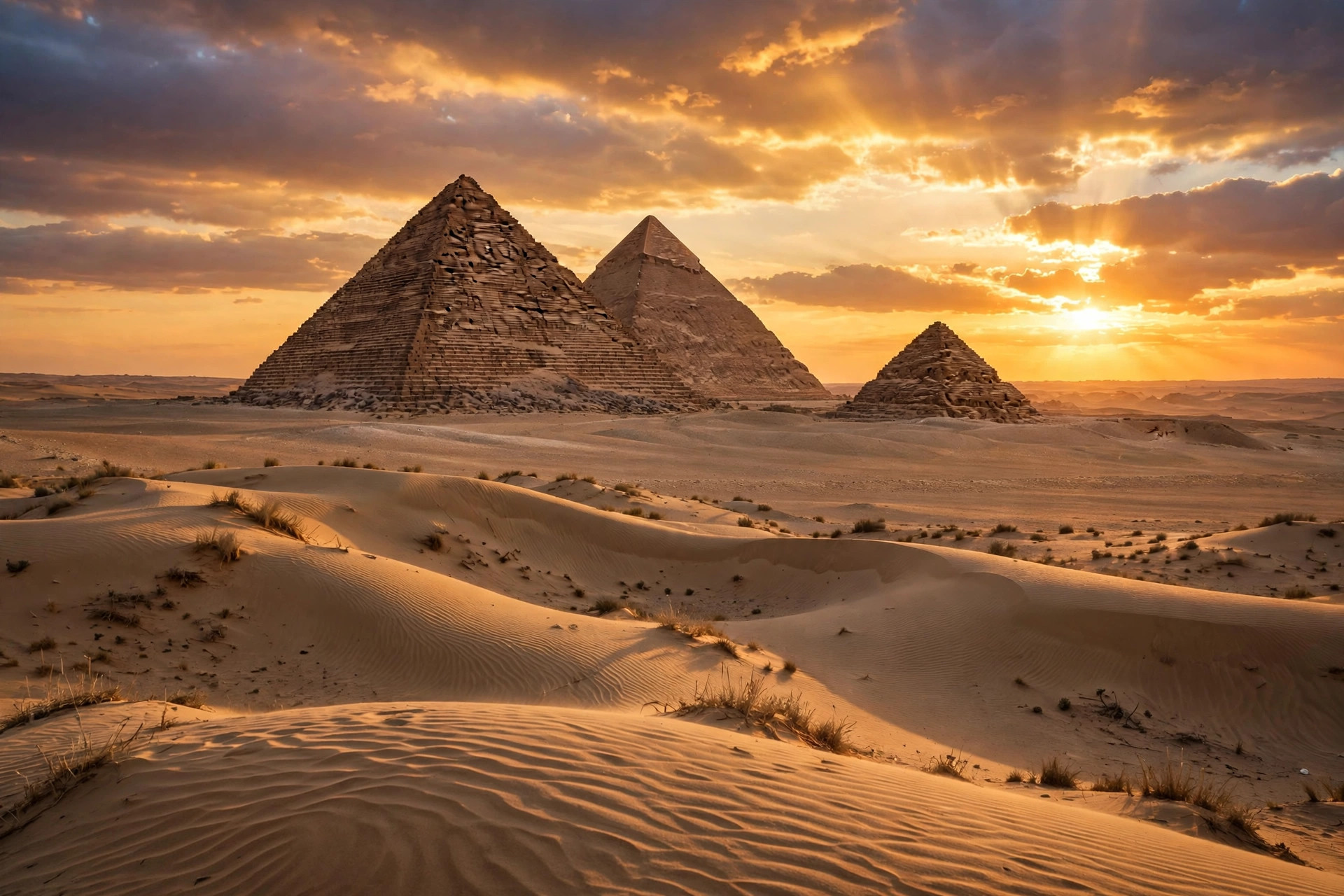
- c. 2686–2181 BCE The Old Kingdom — the Age of the Pyramids — with kings such as Djoser, Khufu, Khafre and Menkaure.
- c. 2560 BCE The Great Pyramid of Khufu is completed at Giza, the largest pyramid ever built and the only surviving Wonder of the Ancient World.
- c. 2055 BCE Mentuhotep II of Thebes reunites Egypt, and the Middle Kingdom begins — a classical age of Egyptian literature.
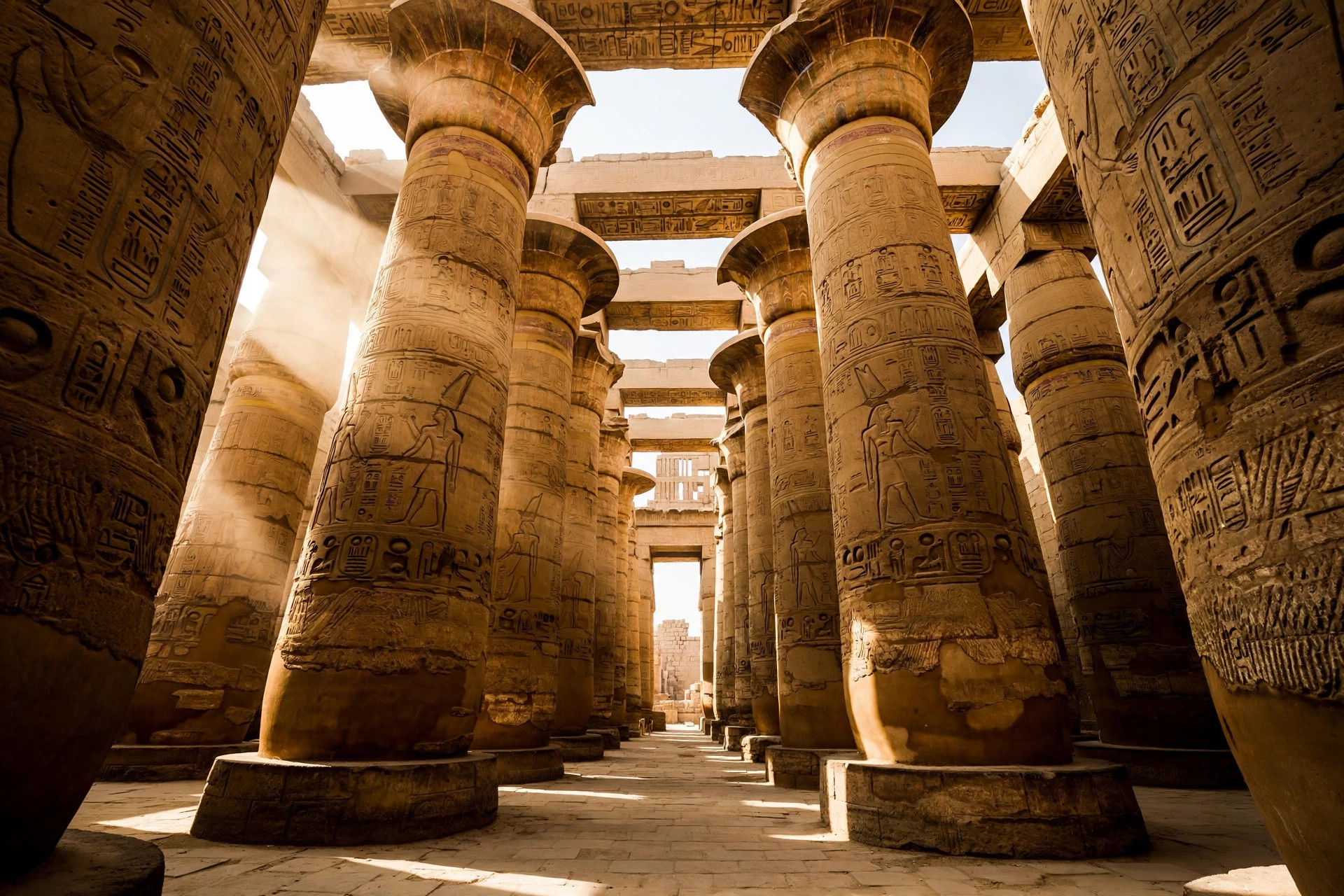
- c. 1550–1070 BCE The New Kingdom — Egypt's imperial peak — the age of Karnak, Luxor Temple and the Valley of the Kings.
- c. 1279–1213 BCE The reign of Ramesses II, Egypt's great builder king; the temples of Abu Simbel are begun around 1264 BCE.
- 332–331 BCE Alexander the Great visits the oracle of Amun at Siwa and founds Alexandria in 331 BCE.
- 30 BCE Rome annexes Egypt after the death of Cleopatra VII, ending more than 3,000 years of pharaonic rule.
- 641–642 CE The Arab conquest of Egypt; Fustat is founded and the Mosque of Amr ibn al-As, the first mosque in Egypt, is built.
- 969 CE The Fatimids found Cairo, al-Qahira, the Victorious; al-Azhar Mosque is founded in 970 CE.
- 1176 CE Saladin begins the Citadel of Cairo to defend the city against the Crusaders.
- 1250–1517 The Mamluk Sultanate rules Egypt; the Mosque-Madrasa of Sultan Hassan is built in 1356–1363.
- 1517 The Ottoman conquest brings Egypt into the Ottoman Empire.
- 1869 The Suez Canal opens, joining the Mediterranean to the Red Sea.
- 1882 Britain occupies Egypt after the bombardment of Alexandria.
- 1902 The Egyptian Museum opens in Cairo on 15 November, and the old Aswan Dam is completed.
- 1922 Howard Carter discovers the tomb of Tutankhamun, KV62, in the Valley of the Kings, on 4 November.
- 23 July 1952 The Free Officers' Revolution; the republic is proclaimed in 1953.
- 1960–1970 The Aswan High Dam is built, and the UNESCO campaign to save the monuments of Nubia runs from 1960 to 1980.
- 1964–1968 The temples of Abu Simbel are cut apart and moved to higher ground above Lake Nasser.
- 1979 Five Egyptian sites are inscribed on UNESCO's World Heritage List, including Giza, Luxor, Nubia and Historic Cairo.
- 1983 Ras Mohammed is declared Egypt's first national park, at the southern tip of Sinai.
- 2002 The Saint Catherine Area is inscribed by UNESCO, and the Bibliotheca Alexandrina opens in Alexandria.
- 3 Apr 2021 The royal mummies are moved to the National Museum of Egyptian Civilisation in the televised Pharaohs' Golden Parade.
- 1 Nov 2025 The Grand Egyptian Museum is inaugurated near Giza, opening to the public on 4 November 2025.
How to Read This Timeline
The timeline is deliberately short: 26 turning points, not an encyclopaedia. Its shape tells the story in miniature. The first seven entries cover more than 1,500 years of pharaonic Egypt, from unification to the reign of Ramesses II, because that is the period visitors see most clearly in the monuments — the pyramids of Giza, the temples of Luxor, the tombs of the Valley of the Kings and the temples of Abu Simbel. The next entries move faster, because Egypt's later history is written in cities rather than in single monuments: Alexandria, founded by Alexander; Fustat and Cairo, founded after the Arab conquest; the Citadel of Saladin and the mosques of the Mamluks.
The last century of the timeline is the most crowded, and that is no accident. The Egyptian Museum opened in 1902, Tutankhamun's tomb was found in 1922, the revolution came in 1952, the High Dam and the rescue of Nubia filled the 1960s, UNESCO recognised Egypt's heritage in 1979, and the Grand Egyptian Museum opened in 2025. The story did not end with the pharaohs. It is still being written, in new museums, in rescued temples and in the travellers who come to see them. Use this timeline as a map: pick a period that interests you, then read the pages of this site that belong to it, and the stones will start to speak in order.