Luxor: Karnak Temple and the Valley of the Kings
Luxor is often called the greatest open-air museum in the world, and the description is deserved. On the east bank of the Nile stand the vast temples of Karnak and Luxor; on the west bank lie the royal tombs of the Valley of the Kings. Together they are the surviving heart of ancient Thebes, a city that was the capital of Egypt for long periods and the holy city of the god Amun.
Ancient Thebes: the city of Amun
Luxor stands on the site of ancient Thebes, the city that served as capital of Egypt for long stretches of the Middle and New Kingdoms and remained the religious heart of the country long after political power moved elsewhere. Thebes was the home of Amun, king of the gods, and its temples were the richest and most powerful in Egypt. The main monuments of Luxor date from about 1500 to 1000 BCE, the great age of the New Kingdom, when Egypt was an empire stretching from Nubia to the Levant.
The ancient Egyptians divided their city by the river. The East Bank was the city of the living, where the temples and the town stood, and the West Bank was the city of the dead, where the kings were buried and their mortuary temples rose against the desert hills. That division is still visible today: modern Luxor, with its temples and its Corniche along the Nile, occupies the East Bank, while the West Bank is a quiet landscape of tombs, temples and fields. UNESCO inscribed "Ancient Thebes with its Necropolis" on the World Heritage List in 1979, recognising the two banks as a single historic landscape.
Karnak Temple: two thousand years of building
Karnak is the largest ancient religious complex in the world. The site covers about 200 acres, though the figure depends on which boundary is counted, and it was built over roughly 2,000 years, from the Middle Kingdom, when Senusret I began work here around 1971 BCE, through to the Roman period. More than thirty pharaohs added to it, each one eager to leave a mark on the house of Amun. The complex was dedicated to the Theban Triad: Amun, his consort Mut and their son Khonsu.
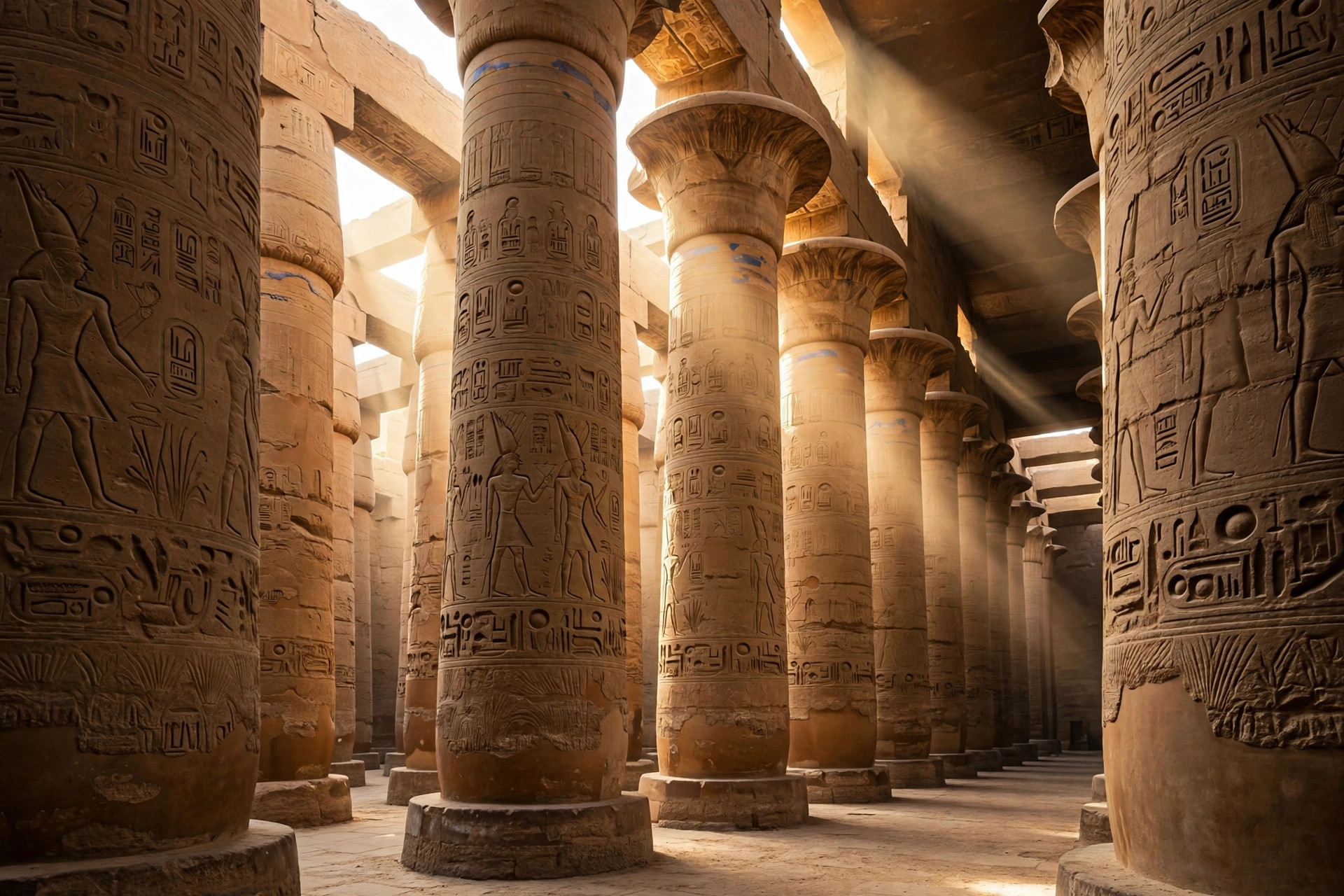
The most famous part of Karnak is the Great Hypostyle Hall, a forest of stone that still overwhelms visitors today. It holds 134 columns, and the central columns rise about 23 metres high, tall enough to hold a seven-storey building. The hall was begun by Seti I and completed by his son Ramesses II, and its columns and walls are covered in carved and painted scenes of kings making offerings to the gods. Walking between the columns, you can still see traces of the original colour on the stone. Beyond the hall lie obelisks, a sacred lake where priests purified themselves, and the great pylon gateways that marked the entrances to the sanctuary. No other temple in Egypt gives the same sense of scale: Karnak was not built in a single reign but grew, generation after generation, into a city of stone.
Luxor Temple and the Avenue of Sphinxes
In the centre of modern Luxor stands Luxor Temple, smaller and more graceful than Karnak, and built for a different purpose. It was raised mainly by Amenhotep III around 1390 BCE and enlarged by Ramesses II, who added the great pylon, a court and colossal statues of himself. One of the two obelisks that once stood before the pylon now stands in the Place de la Concorde in Paris, where it has stood since the 1830s; its twin still rises in Luxor.
Luxor Temple was the destination of the Opet Festival, one of the great religious festivals of ancient Egypt, when the sacred barque of Amun was carried in procession from Karnak to Luxor along the Avenue of Sphinxes. That processional way, 2.7 kilometres long, links the two temples, and most of its sphinxes date from the reign of Nectanebo I in the 4th century BCE. Excavated over decades, the avenue was reopened in 2021, so visitors can once again walk the route the festival took.
The temple also tells the story of the centuries that followed the pharaohs. Inside its courts stands the 13th-century Mosque of Abu el-Haggag, built within the ancient temple, and on some walls survive 4th-century Christian frescoes from the time when part of the temple served as a church. Few places in Egypt show the layers of history as clearly as Luxor Temple, where pharaonic, Christian and Islamic Egypt share the same stones.
The Valley of the Kings
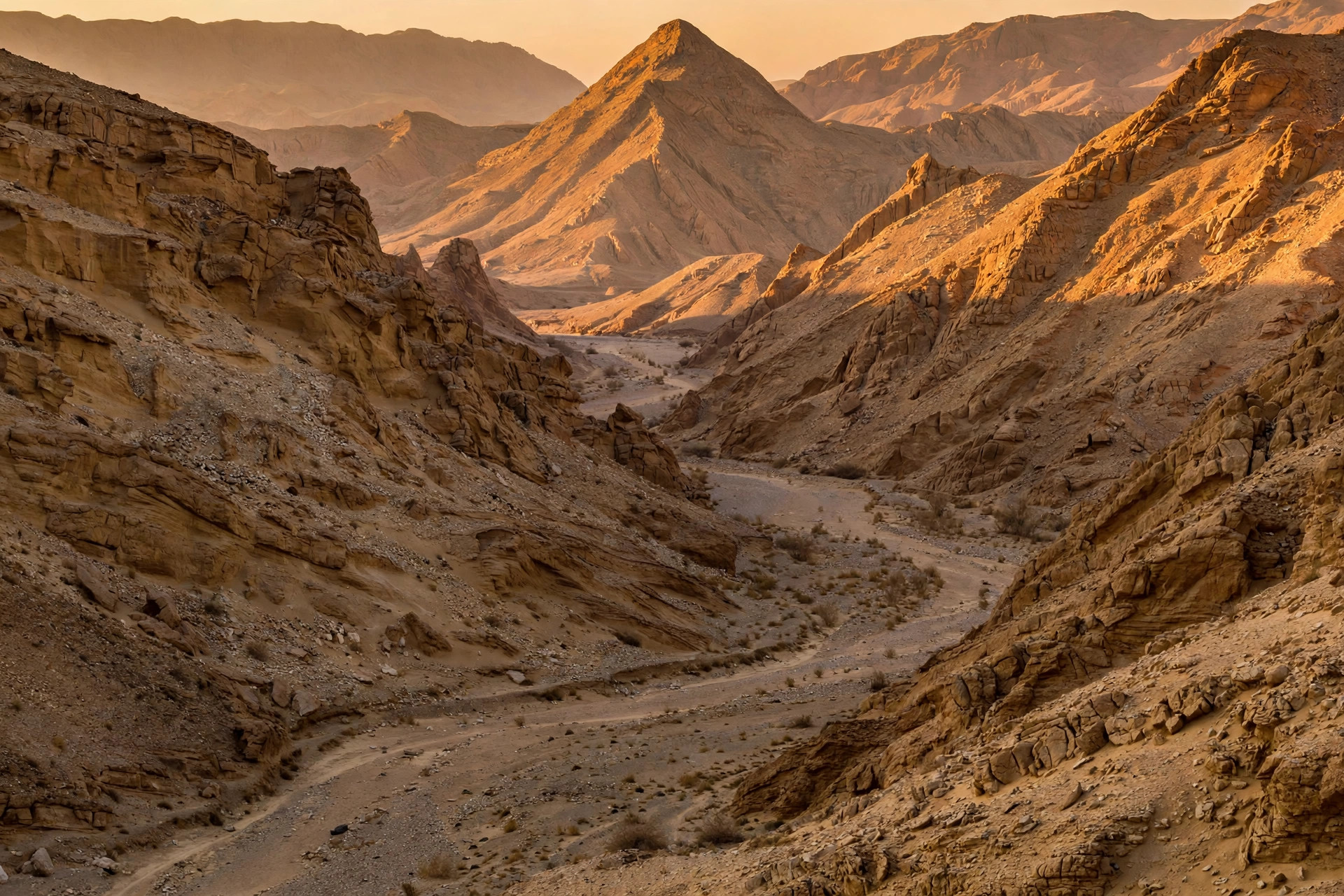
Across the river, in a dry valley hidden behind the Theban hills, lies the Valley of the Kings, the royal necropolis of the New Kingdom from about 1550 to 1070 BCE. Here, from Thutmose I to Ramesses XI, the pharaohs abandoned the pyramid as a royal tomb and were buried instead in deep rock-cut tombs, hidden in the desert and decorated with scenes from the books of the afterlife.
The tombs are numbered KV1 to KV63 in the standard count, 63 tombs in all, with later discoveries reported since — a tomb numbered KV64 was found in 2012, and further tombs have been reported. The most famous is KV62, the tomb of Tutankhamun, discovered by Howard Carter on 4 November 1922. It was the only royal tomb found essentially intact, though it had been entered in antiquity, and it contained more than 5,000 objects, 5,398 catalogued pieces, including the gold mask now displayed at the Grand Egyptian Museum. Other tombs are famous for their painted corridors: the tomb of Seti I, the tomb of Ramesses VI, and the tomb of Thutmose III, whose walls are covered with stick-figure scenes of the journey through the night. Only a small number of tombs are open at any one time, and the selection changes as conservation work moves from tomb to tomb.
The Colossi of Memnon and the West Bank
On the way to the valley, every visitor passes the Colossi of Memnon, two seated statues of Amenhotep III, who reigned around 1388 to 1351 BCE. Each statue is about 18 metres high including its pedestal and weighs around 720 tonnes, and they are all that remains above ground of the king's vast mortuary temple, once the largest temple on the West Bank. The statues were carved from quartzite, and in ancient times one of them was said to sing at dawn, a sound caused by the stone warming in the morning sun.
The West Bank holds far more than the Valley of the Kings. There are the tombs of the nobles, the Valley of the Queens, the temple of Hatshepsut cut into the cliffs at Deir el-Bahari, and the Ramesseum, the mortuary temple of Ramesses II. Taken together with the temples of the East Bank, they make Luxor a place where the whole of New Kingdom Egypt can be walked through in a few days — a capital city, its gods, its kings and its afterlife, all still standing in the open air.
Watch: Pyramids and King Tut (Full Episode) | Lost Treasures of Egypt | National Geographic (National Geographic)
| Ancient name | Thebes, holy city of Amun |
|---|---|
| UNESCO listing | Ancient Thebes with its Necropolis, inscribed 1979 |
| Karnak Temple | Largest ancient religious complex in the world; about 200 acres; built over about 2,000 years by more than 30 pharaohs |
| Great Hypostyle Hall | 134 columns; central columns about 23 m high; begun by Seti I, completed by Ramesses II |
| Luxor Temple | Built mainly by Amenhotep III, c. 1390 BCE; enlarged by Ramesses II; home of the Opet Festival |
| Avenue of Sphinxes | 2.7 km linking Karnak and Luxor Temple; reopened in 2021 |
| Valley of the Kings | Royal necropolis, c. 1550–1070 BCE; tombs numbered KV1–KV63, with later discoveries reported |
| Tutankhamun's tomb | KV62, found by Howard Carter on 4 November 1922; more than 5,000 objects inside |
| Colossi of Memnon | Two seated statues of Amenhotep III, about 18 m high, about 720 tonnes each |
Why it matters
Luxor is where ancient Egypt is at its grandest and most complete. Karnak shows what a temple could become when thirty kings built on the same site for two thousand years; the Valley of the Kings shows how the New Kingdom pharaohs prepared for eternity; and Luxor Temple shows how the same stones served pharaohs, Christians and Muslims in turn. No other city in Egypt holds so much of the ancient world in one place, and no visit to Egypt is complete without it.
