The Pyramids of Giza and the Great Sphinx
On a limestone plateau on the west bank of the Nile, about 13 kilometres south-west of central Cairo, stand the three great pyramids of Giza — the last surviving Wonder of the Ancient World. They are the tombs of three kings of the 4th Dynasty, built in the Old Kingdom more than 4,500 years ago, and beside them crouches the Great Sphinx, the oldest known monumental sculpture in Egypt.
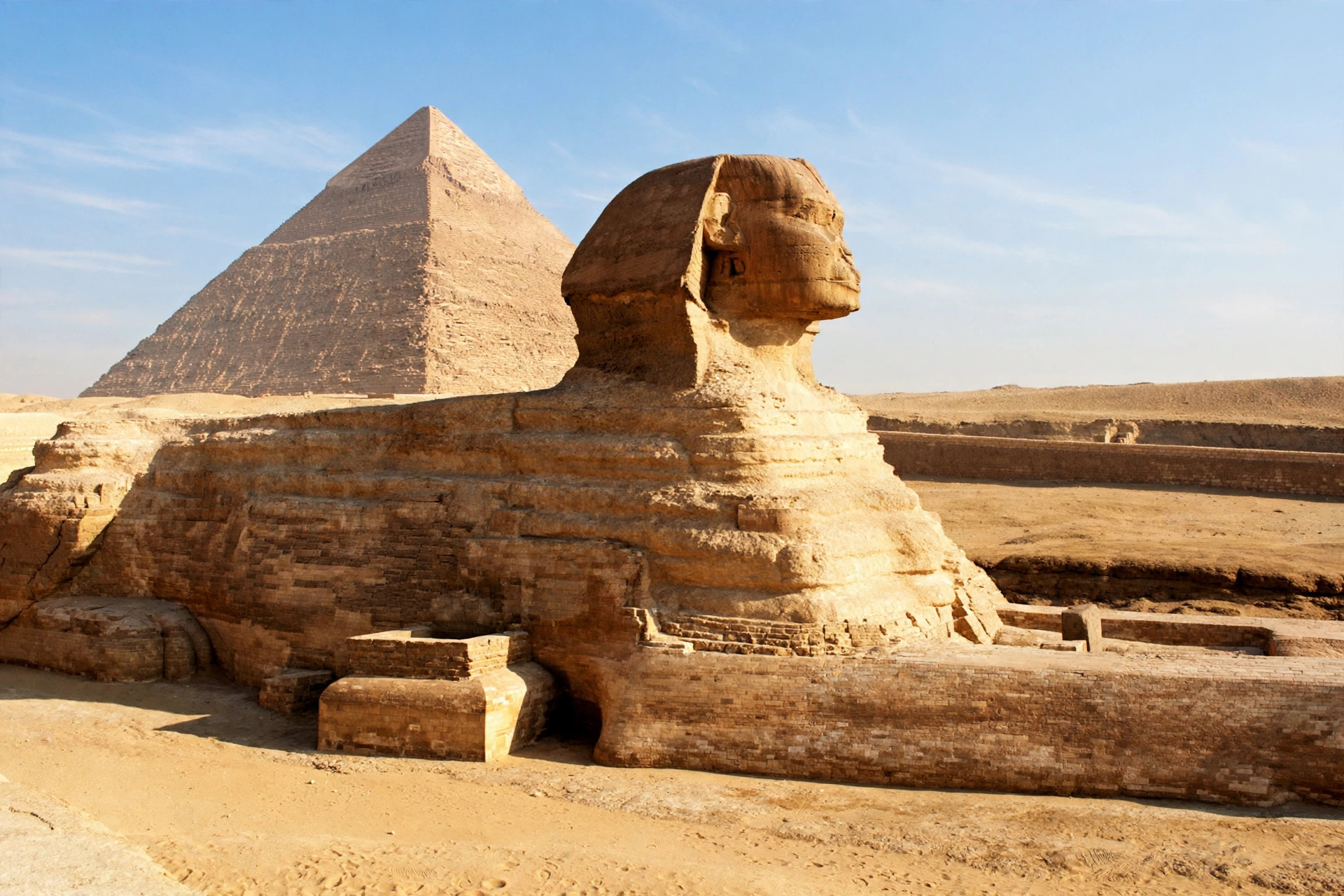
The Great Pyramid of Khufu
The Great Pyramid was built for Khufu, known in Greek as Cheops, around 2580 to 2560 BCE and completed around 2560 BCE, over about 10 to 20 years. Its original height was about 146.6 metres — 280 royal cubits — and its base measures about 230 metres on each side. Today it stands about 138.8 metres high, because the smooth white casing and the pyramidion, the capstone at the top, have been lost over the centuries. It is estimated to contain about 2.3 million blocks, although estimates range from 2 to 2.8 million, and the average block weighs about 2.5 tonnes. For more than 3,800 years it was the tallest structure made by human hands in the world.
The pyramid was not built by a nameless mass of forced labour. The architect traditionally credited with the work is Hemiunu, Khufu's vizier, and the building was carried out by organised teams of skilled Egyptian workers. The evidence is in the ground at Giza itself: a workers' town and cemeteries were found there in 1990, with bakeries, medical care for injuries, and burials near the pyramids — the remains of a workforce that was fed, treated and honoured, not driven. That is the scholarly consensus today, and the old story of slaves building the pyramids does not match what archaeologists have found.
Khafre and Menkaure
The second pyramid belongs to Khafre, known in Greek as Chephren, the son of Khufu, who reigned around 2558 to 2532 BCE. Its original height was about 143.5 metres, and it stands about 136.4 metres today. From a distance it can look as tall as the Great Pyramid, because it stands on higher ground and is steeper, at an angle of about 53 degrees. Near its top it still keeps a cap of the original white Tura limestone casing, the smooth skin that once covered all three pyramids and made them shine in the sun.
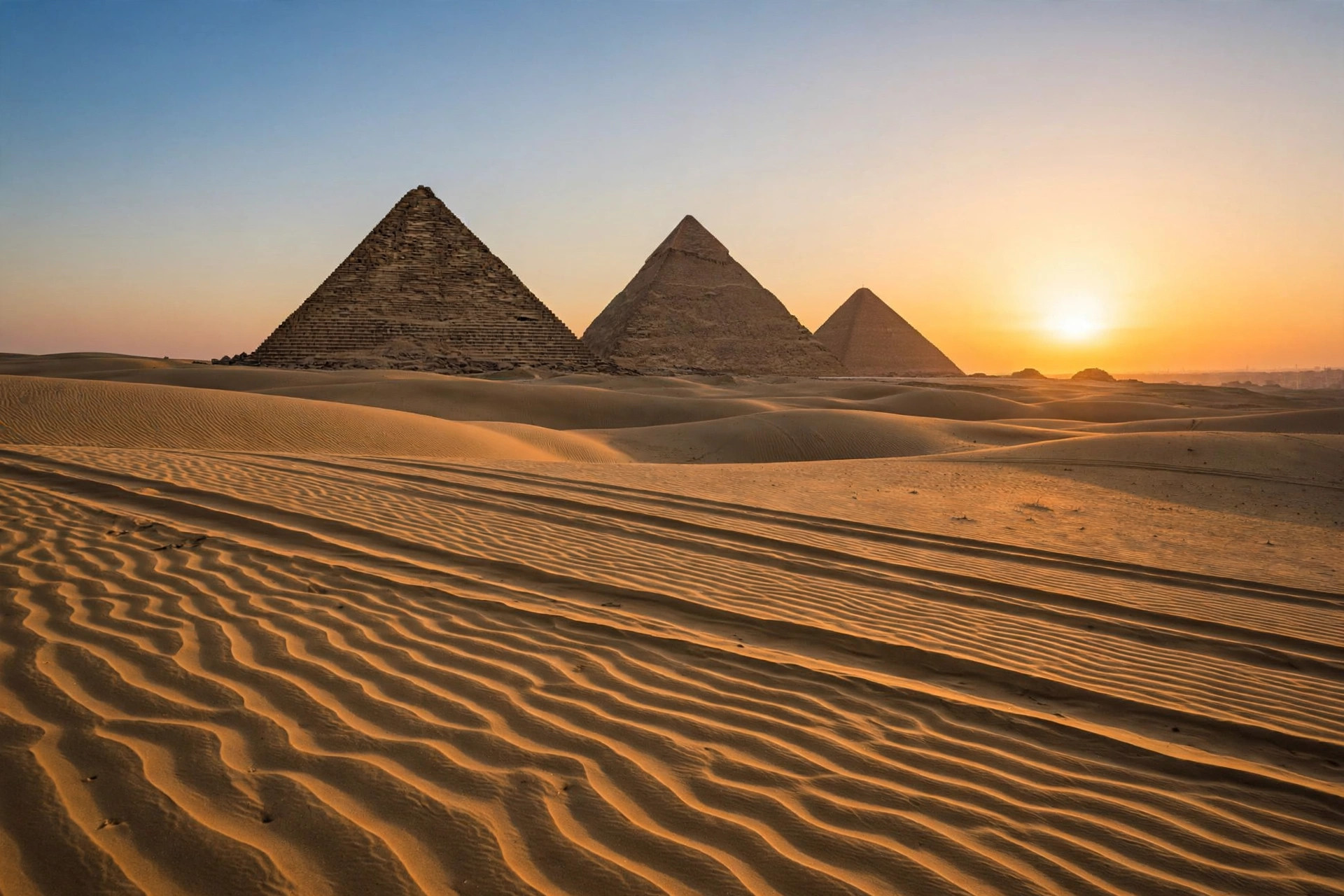
The third pyramid belongs to Menkaure, known in Greek as Mykerinos, probably the son of Khafre, who reigned around 2532 to 2503 BCE. It is the smallest of the three, about 65 metres high when built and about 61 to 62 metres today, and its lowest courses are cased in red granite from Aswan. Around the three pyramids stand smaller pyramids for queens, temples, causeways and the tombs of the officials who served the kings — a whole city of the dead, not three monuments standing alone.
Together the Giza plateau is part of UNESCO's "Memphis and its Necropolis" site, inscribed in 1979, which contains more than 38 pyramids running from Giza to Dahshur. The three at Giza are the most famous, but they belong to a much larger landscape of royal tombs that stretches south along the desert edge.
The Great Sphinx
The Great Sphinx is a lion with a human head, carved from the bedrock of the plateau itself. It is 73 metres long, 20 metres high and 19 metres wide at the haunches, and it is the oldest known monumental sculpture in Egypt. Most scholars attribute it to Khafre: the face is probably his, and the statue is aligned with his pyramid complex, built during his reign around 2558 to 2532 BCE. But there is no contemporary inscription naming the builder, and Khufu and Djedefre have also been proposed. The honest statement is that the Sphinx was most likely built by Khafre — not that this is certain.
The Sphinx has been buried in sand and dug out again many times over its long life, and its nose is missing. No reliable source says who broke it, and the popular story that blames Napoleon is not supported by the evidence — drawings made before his arrival already show the damage. What is certain is that the statue has watched over the plateau for some 4,500 years, and that it remains one of the most recognised monuments in the world.
How they were built
The stone of the pyramids came from several places. The core was local limestone, quarried on the plateau itself. The fine white casing came from Tura, across the river, and was shipped by boat on the Nile and its canals. The granite came from Aswan, far to the south. The transport by boat is confirmed by a remarkable document: the Diary of Merer, a logbook written on papyrus and found at Wadi al-Jarf in 2013, records a crew bringing Tura limestone to Giza during the reign of Khufu. From the river bank the stone was moved on sledges over wetted sand and up ramps.
The exact shape of the ramps is still debated. Some scholars argue for a straight ramp, others for a zigzag ramp, and others for a ramp that spiralled inside the pyramid as it rose. A steep ramp with post-holes, dating from Khufu's time, was found at the Hatnub quarry in 2018, but it does not settle the question for Giza. Workforce estimates also vary: about 4,000 people may have been hauling and setting stone at any one time, with a peak workforce of up to about 40,000 in one engineering study by the archaeologist Mark Lehner. What is not in doubt is the scale of organisation behind it — a state that could feed, house and direct tens of thousands of workers for decades.
| Great Pyramid of Khufu | Built c. 2580–2560 BCE; original height about 146.6 m; base about 230 m per side; about 2.3 million blocks estimated; architect traditionally credited: Hemiunu |
|---|---|
| Pyramid of Khafre | Built c. 2558–2532 BCE; original height about 143.5 m; retains white Tura limestone casing near the top |
| Pyramid of Menkaure | Built c. 2532–2503 BCE; original height about 65 m; lowest courses cased in red Aswan granite |
| Great Sphinx | 73 m long, 20 m high, 19 m wide; carved from the bedrock; most likely built by Khafre, but no inscription names the builder |
| Builders | Organised teams of skilled Egyptian workers, not slaves — shown by the workers' town and cemeteries found at Giza in 1990 |
| UNESCO | Part of "Memphis and its Necropolis", inscribed 1979; more than 38 pyramids from Giza to Dahshur |
Watch: What Archaeologists Found in Unexplored Pyramids | Lost Treasures of Egypt MEGA Episode | Nat Geo (National Geographic)
