Aswan: Philae Temple and Abu Simbel
Aswan is Egypt's southern gateway, a city of granite quarries, palm groves and river islands where Egypt meets Nubia. From here you can reach two of the most remarkable temples in the world: the island sanctuary of Philae, dedicated to the goddess Isis, and the colossal rock-cut temples of Abu Simbel, which were cut apart and rebuilt stone by stone to save them from the rising waters of Lake Nasser.
Aswan: the gateway to Nubia
Aswan stands on the east bank of the Nile, 899 kilometres south of Cairo, at the First Cataract, the rocky rapids that marked the southern frontier of ancient Egypt. Beyond Aswan lay Nubia and the road to Sudan, and for thousands of years the city was a trading post where gold, ivory, ebony and spices from the south changed hands. The granite of Aswan was famous too: the stone for obelisks, statues and the casing of pyramids was quarried here and shipped down the Nile.
Today Aswan is the most relaxed of Egypt's great historic cities, a place of granite islands, feluccas on the river and Nubian villages painted in bright colours. It is also the starting point for the journey south to Abu Simbel and the base for the temples of Nubia that were rescued when the High Dam was built. Together with Philae, the Nubian monuments from Abu Simbel to Philae were inscribed by UNESCO on the World Heritage List in 1979.
Philae Temple: the island of Isis
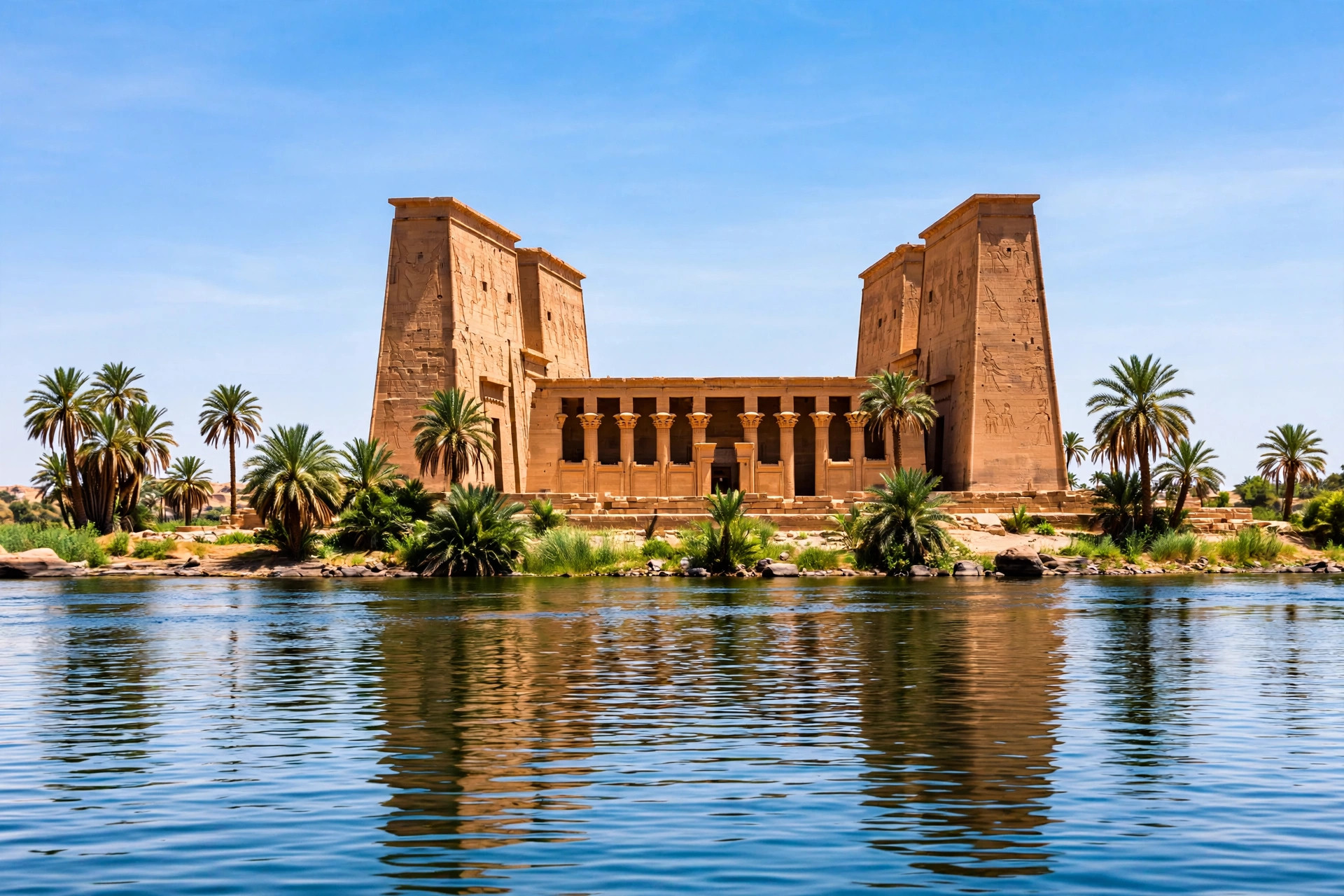
Philae was the great island sanctuary of Isis, the goddess whose cult spread across the whole Roman world. The temple is mostly Graeco-Roman in date: work began under Ptolemy II in the 3rd century BCE, and later rulers added a temple of Hathor and the elegant open pavilion known as Trajan's Kiosk. For centuries pilgrims came to the island to worship Isis, and the last dated hieroglyphic inscription known anywhere was carved at Philae in 394 CE. The cult of Isis continued until the Emperor Justinian ordered the temples closed in the 6th century, and the temple was converted into a church around 540 CE.
Philae was almost lost to the modern age. The old Aswan Dam, completed in 1902, left the island flooded for much of each year, and the building of the High Dam threatened to submerge it completely. In one of the last great rescues of the UNESCO Nubia campaign, the temple was dismantled stone by stone and rebuilt on the higher neighbouring island of Agilkia, 500 metres away, with work beginning in 1972. The temple you visit today stands on its new island, reached by boat across the Nile, its colonnades and pylons reflected in the water just as they were on the original Philae.
Abu Simbel: the temples of Ramesses II
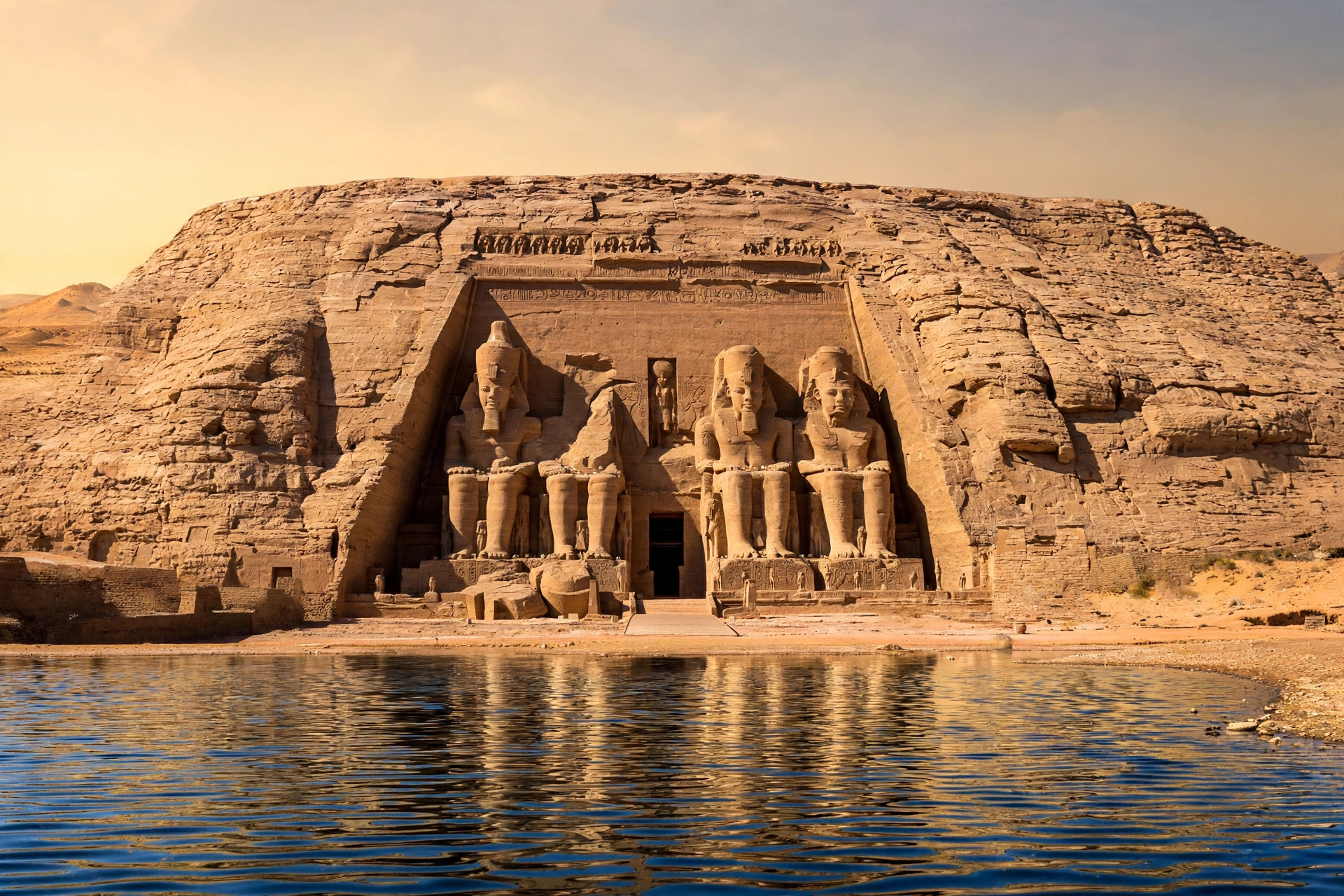
About 230 kilometres south-west of Aswan, near the Sudanese border, stand the two rock-cut temples of Abu Simbel, the most famous monuments of Nubia. They were built by Ramesses II of the 19th Dynasty; construction began around 1264 BCE and took about twenty years, finishing around 1244 BCE. The Great Temple was dedicated to Amun-Ra, Ra-Horakhty and Ptah, with Ramesses II himself shown among the gods. Four seated colossi of the king, each about 20 metres high, guard the facade, though one of them collapsed in an ancient earthquake and still lies in pieces at the foot of the temple. The smaller temple was dedicated to Hathor and to Ramesses II's great royal wife, Queen Nefertari, an unusual honour: her statues stand as tall as the king's on the facade.
The temples were built in part to celebrate the victory at the Battle of Kadesh in 1274 BCE, and in part as a statement of power on Egypt's southern frontier, where every traveller entering Egypt from Nubia would see the face of Ramesses II carved into the cliff. Inside the Great Temple, the walls are covered with painted reliefs of the battle and of the king making offerings to the gods, and the colours have survived remarkably well in the dry desert air.
The sun alignment
Twice a year, on 22 February and 22 October, something extraordinary happens inside the Great Temple. The rays of the rising sun travel about 60 metres down the temple axis and strike three of the four statues in the sanctuary — Amun-Ra, Ramesses II and Ra-Horakhty — lighting them for about twenty minutes. The fourth statue, Ptah, god of the underworld, stays in shadow, as he always has. Before the temples were moved, the alignment fell on 21 February and 21 October; the relocation shifted the dates by a day.
Visitors often hear that the two dates mark the birthday and the coronation day of Ramesses II. That is the popular explanation, but it is disputed: some scholars argue instead that the dates marked the turning points of the agricultural seasons. What is certain is that the builders of Abu Simbel planned the temple with the sun in mind, and that the alignment still works today, more than three thousand years after the temple was carved.
The great rescue and the High Dam
Abu Simbel was saved by one of the greatest engineering feats of the 20th century. When the Aswan High Dam was built between 1960 and 1970, the rising waters of Lake Nasser threatened to drown the temples forever. Between 1964 and 1968, under the UNESCO International Campaign to Save the Monuments of Nubia, the two temples were cut into 1,036 blocks, some weighing up to 30 tonnes and most around 20 tonnes, and reassembled 65 metres higher and about 200 metres back from the river, inside an artificial hill built over concrete domes. The temples were inaugurated on their new site on 22 September 1968.
The dam itself was a vast undertaking: construction began on 9 January 1960 and was completed on 21 July 1970. The rock-and-clay embankment is 111 metres high and about 3,830 metres long, and it created Lake Nasser, one of the largest artificial lakes in the world, about 5,250 square kilometres in area and about 500 kilometres long, with about 83 percent of it in Egypt and the Sudanese part called Lake Nubia. The lake was full by 1976. The dam ended the annual Nile flood and generates hydroelectric power for the country.
But the dam also had a heavy human cost, and it must be part of the story. Lake Nasser flooded Lower Nubia, and between 100,000 and 120,000 Nubians in Egypt and Sudan were resettled, including about 50,000 Egyptian Nubians moved to new villages near Kom Ombo, known as New Nubia, while the Sudanese town of Wadi Halfa was flooded. The UNESCO campaign itself ran from 1960 to 1980, launched on 8 March 1960 and formally closed on 10 March 1980, with more than fifty countries taking part and twenty-two monuments moved. It was this campaign that led directly to the 1972 World Heritage Convention, so the rescue of Abu Simbel helped create the system that now protects historic places around the world.
Watch: Ancient Egypt's Lost Secrets: Tutankhamun, Pyramids & Ramses | MEGA Episode | National Geographic (National Geographic)
| Location | East bank of the Nile, 899 km south of Cairo; First Cataract; gateway to Nubia |
|---|---|
| Philae Temple | Island sanctuary of Isis, begun by Ptolemy II in the 3rd century BCE; rebuilt on Agilkia island from 1972 |
| Last hieroglyphs | The last dated hieroglyphic inscription known was carved at Philae in 394 CE |
| Abu Simbel | Two rock-cut temples of Ramesses II, begun c. 1264 BCE, about 20 years to build; about 230 km south-west of Aswan |
| Great Temple colossi | Four seated statues of Ramesses II, each about 20 m high; one collapsed in an ancient earthquake |
| Sun alignment | 22 February and 22 October; sunlight reaches three of the four sanctuary statues for about 20 minutes |
| UNESCO relocation | 1964–1968; cut into 1,036 blocks and rebuilt 65 m higher and about 200 m back; inaugurated 22 September 1968 |
| Aswan High Dam | Built 1960–1970; 111 m high, about 3,830 m long; created Lake Nasser, about 5,250 km² |
| UNESCO listing | Nubian Monuments from Abu Simbel to Philae, inscribed 1979 |
Why it matters
Aswan is where Egypt's story meets its greatest rescue. Philae and Abu Simbel are not only masterpieces of ancient building — the island temple of Isis and the cliff temples of Ramesses II — they are also the reason the world learned to save its heritage. The campaign that moved them, stone by stone, created the World Heritage Convention itself. To stand before the colossi of Abu Simbel is to see both ancient Egypt at its most powerful and the modern world at its most determined to protect it.