Islamic Cairo: Citadel, Mosques and Khan el-Khalili
Islamic Cairo is one of the great historic cities of the world. Its streets hold hundreds of monuments from the Fatimid, Ayyubid and Mamluk periods: mosques and madrasas, citadels and caravanserais, gates and bazaars, built over more than a thousand years. UNESCO inscribed Historic Cairo on the World Heritage List in 1979, and the old city is still a living place, where the monuments stand among workshops, cafés and crowded lanes.
The founding of Cairo: Fustat and the Fatimids
Islamic Cairo began with Fustat, founded in 641–642 CE after the Arab conquest of Egypt, beside the fortress of Babylon. Fustat was the first Islamic capital of Egypt, a camp city that grew into a great trading town, and its Mosque of Amr ibn al-As, founded in 641–642 CE, was the first mosque in Egypt and in Africa. Three centuries later, in 969 CE, the Fatimids founded a new walled city to the north and named it al-Qahira, "the Victorious" — the Cairo of today. The Fatimid city was a royal enclosure of palaces and mosques, entered through great gates: Bab al-Futuh and Bab al-Nasr, built in the 11th century, still stand at the northern end of the city, and Bab Zuweila, built in 1092, guards the southern end.
Through the Fatimid city runs Al-Muizz Street, one of the oldest streets in Cairo, lined with mosques, madrasas, mausoleums and palaces from nearly every century of the city's history. To walk it is to walk through the whole of Islamic Cairo in a single street, from the Fatimid gates to the Mamluk monuments and the bazaar of Khan el-Khalili. The UNESCO listing of Historic Cairo takes in all of this: Fustat, the Mosque of Ibn Tulun, the Citadel, the Fatimid nucleus and its necropolises.
The Mosque of Ibn Tulun and Al-Azhar
The oldest mosque in Cairo surviving in close to its original form is the Mosque of Ibn Tulun, built between 876 and 879 CE by Ahmad ibn Tulun, the ruler who made Egypt independent of Baghdad for a time. It stands in the quarter of al-Qata'i, the city Ibn Tulun built for himself, and its vast courtyard covers about 26,000 square metres, one of the largest mosque courtyards in the world. Its most famous feature is the spiral minaret, inspired by the great mosque of Samarra in Iraq, which rises outside the mosque like a stone staircase winding into the sky. The mosque is built of brick and plaster, plain and powerful, and it has survived more than eleven centuries almost unchanged.
A century later, the Fatimids founded the Mosque of Al-Azhar in 970 CE, and with it one of the oldest universities in the world. Al-Azhar became a centre of Sunni learning whose influence spread across the Islamic world, and it remains a university and a place of study today. The mosque stands beside Khan el-Khalili, and its minarets rise over the bazaar. Together, Ibn Tulun and Al-Azhar show the two great ages of early Islamic Cairo: the independent Tulunid city of the 9th century and the Fatimid capital of the 10th.
The Citadel of Saladin and the Mosque of Muhammad Ali
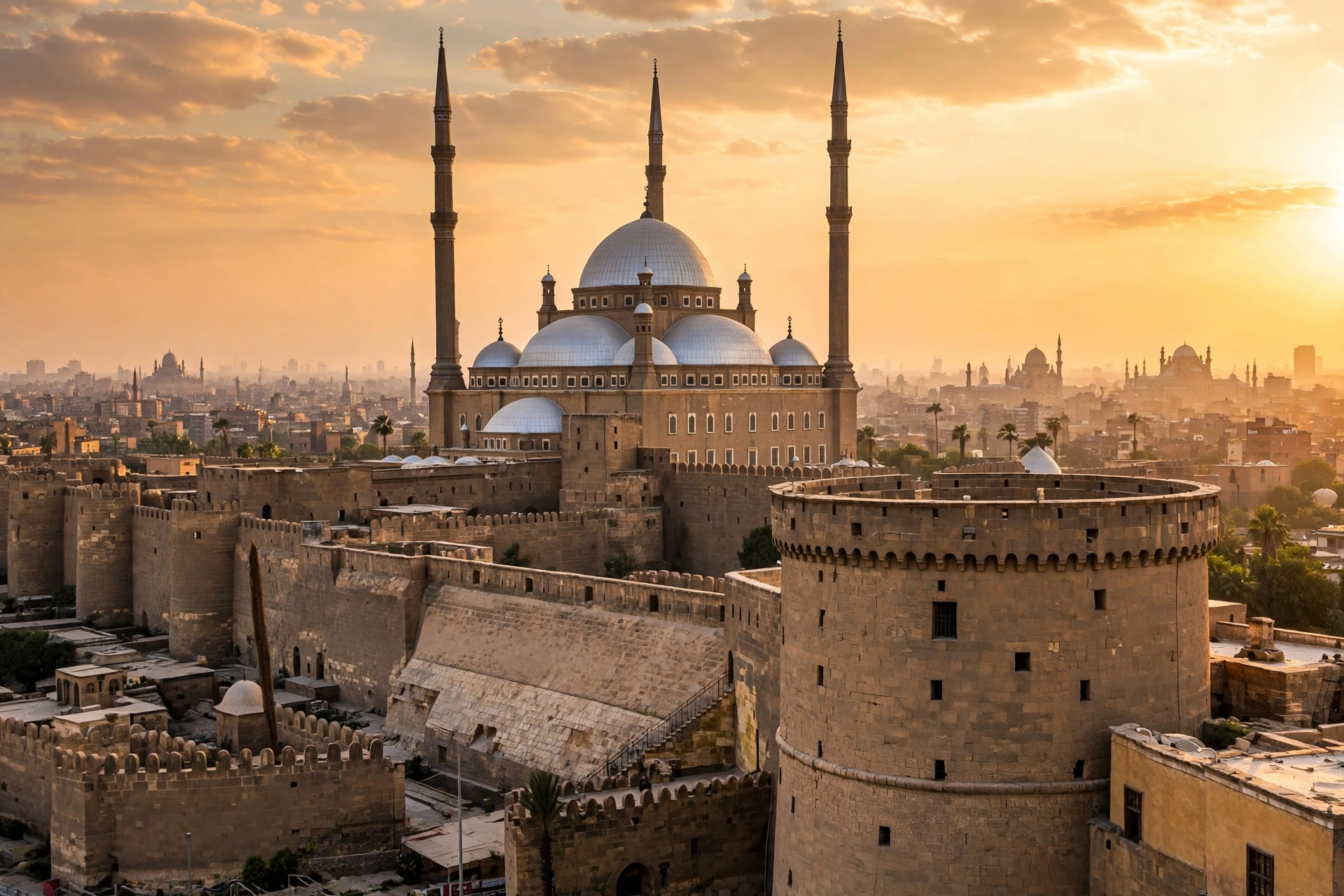
On a spur of the Muqattam Hills, overlooking the city, stands the Citadel of Saladin. It was begun in 1176 CE by Saladin, the founder of the Ayyubid dynasty, to defend Cairo against the Crusaders, and it was finished around 1207 under his Ayyubid successors. For about seven hundred years the Citadel was the seat of Egypt's rulers, and from its walls the sultans and pashas governed the country. Inside its walls, the later rulers built palaces, barracks, museums and mosques, and the Citadel became a city within the city.
The most visible of its buildings is the Mosque of Muhammad Ali, built between 1830 and 1848 by Muhammad Ali Pasha, the ruler who founded modern Egypt. It is an Ottoman-style mosque, clad inside in alabaster, with slender minarets and a great dome that dominates the skyline of Cairo. From the terrace of the Citadel, on a clear day, you can see the pyramids of Giza on the western horizon — the old capital of the pharaohs and the fortress of the sultans in a single view.
Sultan Hassan and the Mamluk city
The greatest monument of Mamluk Cairo is the Mosque-Madrasa of Sultan Hassan, built between 1356 and 1363 by the Mamluk Sultan Hassan. It is one of the largest and finest Mamluk monuments in the world: a vast stone building whose great portal rises like a cliff above the square, and whose four iwans — great vaulted halls — open onto a central courtyard. The four iwans taught the four Sunni schools of law, so the building was both a mosque and a university. Its scale is deliberate: the Mamluks, who ruled Egypt from 1250 to 1517, built to impress, and Sultan Hassan is their masterpiece.
Opposite it stands the Mosque of Al-Rifa'i, completed in 1912, a 19th-century building in Mamluk style that houses the tombs of members of the royal family of the Muhammad Ali dynasty. The two mosques face each other across the square at the foot of the Citadel, and together they mark the centre of Mamluk Cairo — a city of stone, of carved portals and patterned domes, built by sultans who saw architecture as the measure of their reign.
Khan el-Khalili and the City of the Dead
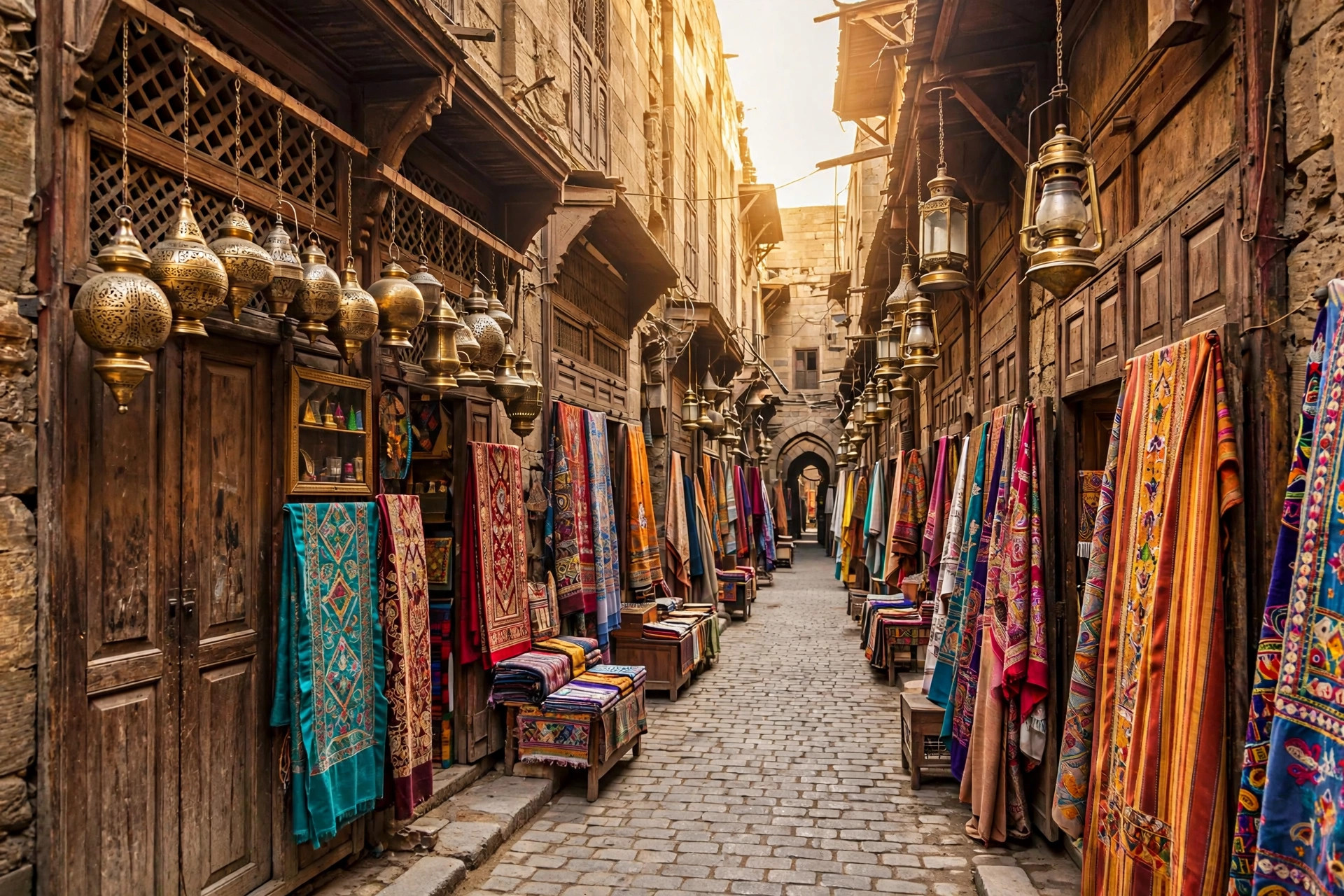
At the heart of the old city lies Khan el-Khalili, founded in 1382 CE by the Emir Djaharks el-Khalili as a market and caravanserai beside Al-Azhar. It has been Cairo's main bazaar ever since: a maze of lanes filled with workshops and shops, where brass, copper, gold, textiles, spices and glass are made and sold as they have been for six centuries. The lanes are narrow and roofed, the cafés are old, and the craftsmen still work at their benches in the open. It is the most alive of Cairo's historic places, a market that never stopped being a market.
On the eastern edge of the city lies another world: the City of the Dead, the historic necropolis known as the Qarafa, where mausoleums, mosques and tombs stand alongside inhabited neighbourhoods. People have lived among the tombs here for generations, and the district is part of the UNESCO Historic Cairo listing — its named necropolises include those of al-Imam al-Shaf'i, al-Sayyidah Nafisah and Qaytbay. It is a place where the city's history is not kept behind walls: the dead and the living share the same streets, and the monuments of a thousand years stand beside the homes of the families who live among them.
| Fustat founded | 641–642 CE, after the Arab conquest; Mosque of Amr ibn al-As, the first mosque in Egypt and Africa |
|---|---|
| Cairo founded | 969 CE by the Fatimids; al-Qahira, "the Victorious" |
| Mosque of Ibn Tulun | Built 876–879 CE; oldest mosque in Cairo surviving in close to its original form; courtyard about 26,000 m²; spiral minaret inspired by Samarra |
| Al-Azhar Mosque | Founded 970 CE; one of the world's oldest universities and a centre of Sunni learning |
| Citadel of Saladin | Begun 1176 CE by Saladin, finished c. 1207; seat of Egypt's rulers for about 700 years |
| Mosque of Muhammad Ali | Built 1830–1848 by Muhammad Ali Pasha; Ottoman style, alabaster-clad; dominates the Cairo skyline |
| Mosque-Madrasa of Sultan Hassan | Built 1356–1363 by the Mamluk Sultan Hassan; four iwans teaching the four Sunni schools of law |
| Khan el-Khalili | Founded 1382 CE by Emir Djaharks el-Khalili; Cairo's main bazaar ever since |
| UNESCO listing | Historic Cairo, inscribed 1979 |
Why it matters
Islamic Cairo is a thousand years of history that never became a museum. Its mosques are still prayed in, its bazaar still trades, and its streets still follow the plan of the Fatimid city. From Ibn Tulun's 9th-century courtyard to Sultan Hassan's great portal and the Citadel's skyline, the old city shows how each dynasty of Egypt built on the last — and how a city founded in 969 is still, more than a thousand years later, the beating heart of Cairo.
