Nubia and Its Temples
Nubia is the land along the Nile south of the First Cataract at Aswan, stretching to Dongola, past the Fourth Cataract, in what is now Sudan. It was home to the Kingdom of Kush, a great African civilisation that traded with, fought with, and at one point ruled Egypt — and its temples, rescued from the rising waters of Lake Nasser in one of the greatest salvage operations in history, are among the most dramatic sights in Egypt.
The Land of Kush
Nubia is divided into Lower Nubia, between the First and Second Cataracts — much of it now lying under Lake Nasser — and Upper Nubia, further south in Sudan. The Kingdom of Kush grew up here, first centred on Kerma, from around 2500 BCE, reaching its height around 1750–1500 BCE, and later on the cities of Napata and then Meroë. Kush was rich in gold, ivory, ebony and other goods that Egypt wanted, and the two lands were bound together by trade, war and shared religion for thousands of years.
The high point of Kushite power came when Kushite kings of the 25th Dynasty, around 732–653 BCE, conquered and ruled Egypt itself. Kings such as Piye, also called Piankhy, and Taharqa ruled the whole Nile Valley from their capital at Napata, and they built temples and pyramids of their own. The 25th Dynasty is sometimes called the Nubian Dynasty, and it is a reminder that the flow of power along the Nile did not run in one direction only. Later, the centre of Kush moved south to Meroë, where the kingdom flourished for centuries more.
For the traveller today, Nubia means two things at once: the great rescued temples along the Nile between Aswan and Abu Simbel, and the living Nubian culture of the villages around Aswan, whose people keep their own languages and customs. The two belong together. The temples tell the ancient story, and the villages show that Nubia is not only archaeology.
Abu Simbel: The Temples of Ramesses II
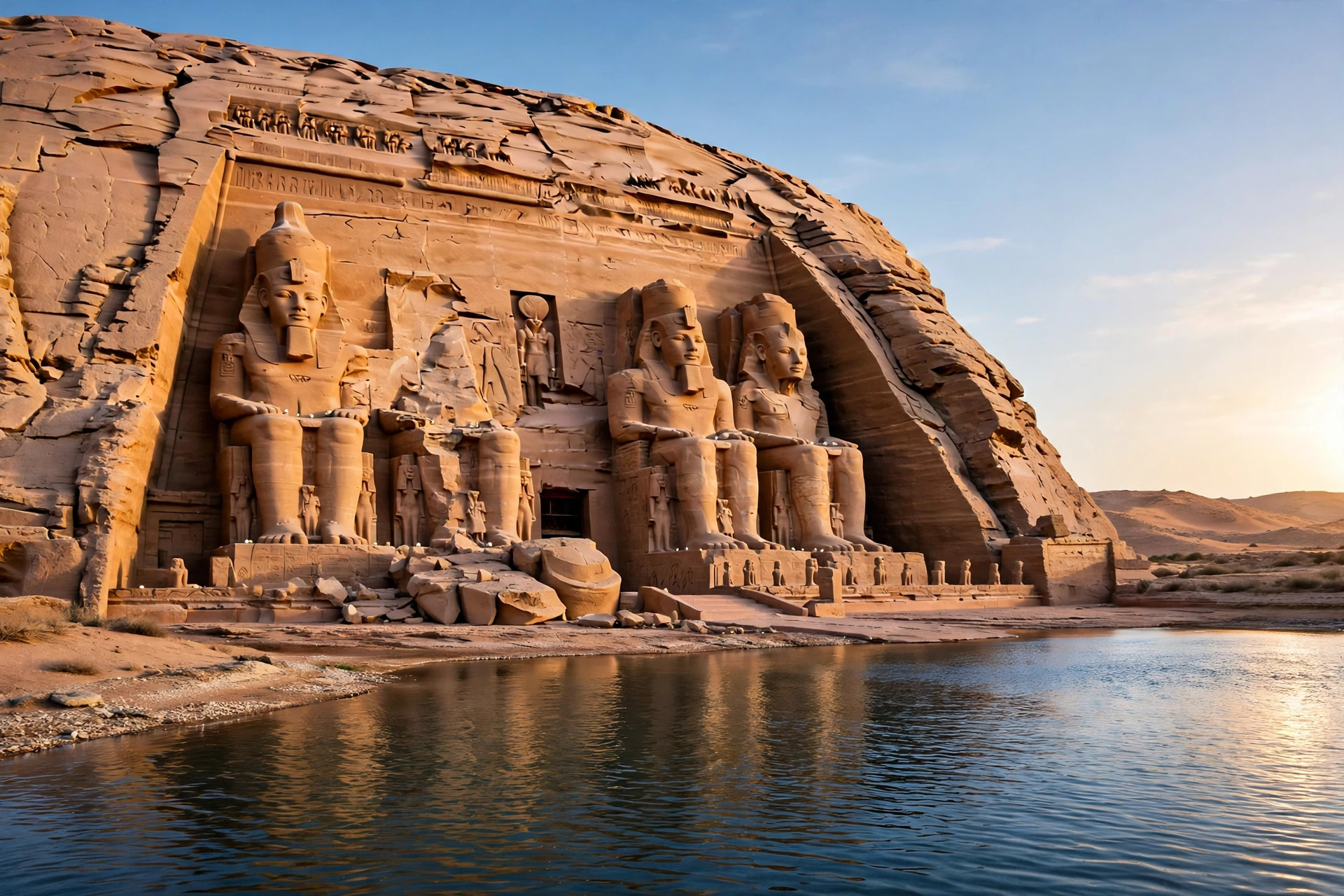
The most famous monuments of Nubia stand near the Sudanese border, about 230 kilometres south-west of Aswan, or about 280–300 kilometres by road. Abu Simbel is two rock-cut temples built by Ramesses II of the 19th Dynasty. Construction began around 1264 BCE and took about twenty years, to around 1244 BCE. The Great Temple is dedicated to the gods Amun-Ra, Ra-Horakhty and Ptah, with Ramesses II himself seated among them in the sanctuary. Four seated colossi of Ramesses II guard the facade, each about 20 metres high, and one of them collapsed in an ancient earthquake. The smaller temple is dedicated to the goddess Hathor and to Queen Nefertari. The temples were built in part to celebrate the victory at the Battle of Kadesh, fought in 1274 BCE.
Abu Simbel is also famous for its sun alignment. On 22 February and 22 October each year, the rising sun sends its rays about 60 metres down the axis of the Great Temple and lights up three of the four statues in the sanctuary — Amun-Ra, Ramesses II and Ra-Horakhty — for about twenty minutes. Ptah, god of the underworld, stays in shadow. Before the temples were moved, the dates were 21 February and 21 October; the move shifted them by a day. The popular explanation is that the dates mark the birthday and the coronation of Ramesses II, but some scholars say they marked the agricultural seasons instead, so the birthday story should be treated as tradition rather than settled fact.
When the Aswan High Dam was built, Abu Simbel faced flooding by Lake Nasser. Between 1964 and 1968, in the most famous operation of the UNESCO rescue campaign, the temples were cut into 1,036 blocks, weighing up to 30 tonnes each and mostly around 20 tonnes, and reassembled 65 metres higher and about 200 metres back from the river, inside an artificial hill raised over concrete domes. The temples were inaugurated on their new site on 22 September 1968.
Philae and the Other Rescued Temples
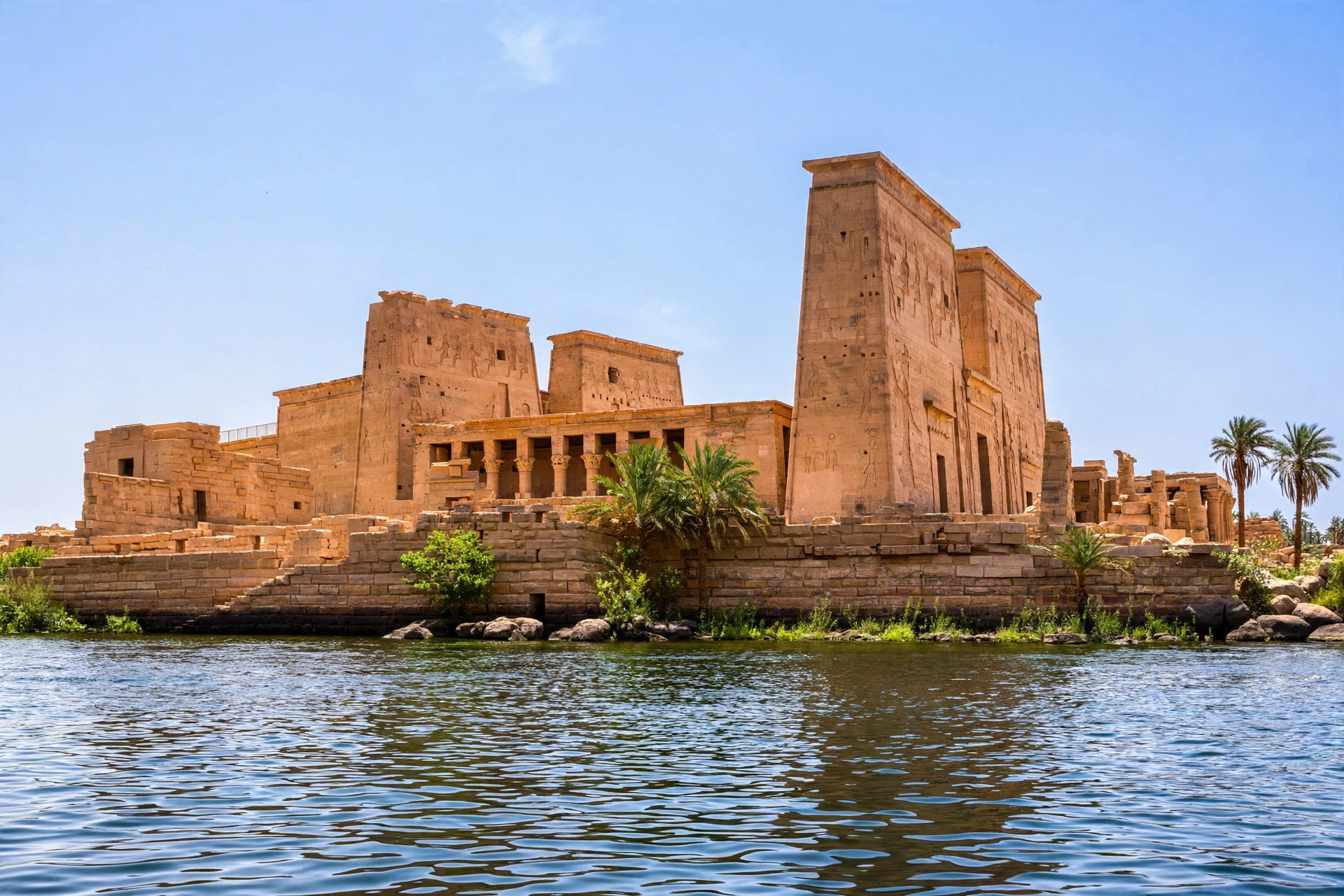
Philae, the island sanctuary of the goddess Isis, is the most beautiful of the rescued temples. It is mostly Graeco-Roman in date, begun by Ptolemy II in the 3rd century BCE, with a temple of Hathor and the elegant open pavilion known as Trajan's Kiosk added later. The last dated hieroglyphic inscription known anywhere was carved at Philae in 394 CE, and the cult of Isis continued there until the Emperor Justinian ordered the temples closed in the 6th century; the temple was converted into a church around 540 CE. Philae was first threatened by the old Aswan Dam, completed in 1902, which left the island flooded for much of each year, and then by the High Dam. It was dismantled and rebuilt on the higher island of Agilkia, 500 metres away, with work beginning in 1972 — the last major rescue of the UNESCO Nubia campaign.
Other temples were saved in the same campaign. Kalabsha Temple, built by the Roman Emperor Augustus around 30 BCE for the Nubian god Mandulis, is the largest sandstone temple in Nubia. It was dismantled and rebuilt near the High Dam in the early 1960s, with West German funding — the first temple moved in the UNESCO campaign. Nearby stands Beit el-Wali, a small rock-cut temple built by Ramesses II, one of his five Nubian temples, with vividly coloured reliefs and war scenes; it was moved with Kalabsha. Amada, built under Thutmose III and Amenhotep II, is the oldest surviving temple of Lower Nubia, and Wadi es-Sebua, Dakka, Maharraqa and Derr were also rescued. Not everything could be saved: Gerf Hussein, the chapels of Qasr Ibrim and the temple of Abu Oda were among the sites that were recorded and left to flood. Two temples were given away in thanks for foreign help: the Temple of Debod now stands in Madrid, and the Temple of Dendur stands in the Metropolitan Museum in New York.
| Region | Nubia — the Nile Valley south of the First Cataract at Aswan to Dongola in Sudan |
|---|---|
| Kingdom of Kush | Kerma from c. 2500 BCE, then Napata, then Meroë; Kushite 25th Dynasty ruled Egypt c. 732–653 BCE |
| Abu Simbel built | Begun c. 1264 BCE by Ramesses II; took about 20 years; four facade colossi about 20 m high |
| Abu Simbel moved | 1964–1968: cut into 1,036 blocks, reassembled 65 m higher and about 200 m back from the river |
| Sun alignment | 22 February and 22 October each year; three sanctuary statues lit for about 20 minutes |
| Philae | Island sanctuary of Isis, begun by Ptolemy II in the 3rd century BCE; rebuilt on Agilkia island, work beginning 1972 |
| Kalabsha | Built by Emperor Augustus c. 30 BCE; largest sandstone temple in Nubia; first temple moved in the UNESCO campaign |
| UNESCO listing | Nubian Monuments from Abu Simbel to Philae, inscribed 1979 |
Jebel Barkal Is in Sudan, Not in Egypt
One famous Nubian site is often wrongly listed as Egyptian, so it is worth stating plainly: Jebel Barkal, also spelled Gebel Barkal, is in Sudan. It is a 104-metre flat-topped mesa near Karima, in Northern State, Sudan, about 400 kilometres north of Khartoum. It was a sacred mountain since New Kingdom times, from around 1500 BCE. Thutmose III founded the city of Napata there around 1450 BCE, and the Temple of Amun, known as B500 and measuring 46 by 160 metres, was built in the 13th century BCE, probably founded under Thutmose III and shaped under him and Ramesses II, then greatly expanded by the Kushite king Piye. Napata became the capital of the Kingdom of Kush after around 800 BCE. UNESCO inscribed Jebel Barkal and the Sites of the Napatan Region as a World Heritage Site in 2003, covering the Napatan period of 900–270 BCE and the Meroitic period of 270 BCE–350 CE. It belongs to the same Kushite story as the temples of Egyptian Nubia, but it stands across the modern border, in Sudan, and no honest guide to Egypt should claim it as an Egyptian site.
Nubian Culture Today
The rescue of the temples came at a heavy human cost, and no account of Nubia should present the High Dam as a pure triumph. Lake Nasser flooded Lower Nubia, and 100,000–120,000 Nubians in Egypt and Sudan were resettled. About 50,000 Egyptian Nubians were moved to new villages near Kom Ombo, in an area known as New Nubia, and the Sudanese town of Wadi Halfa was flooded. The UNESCO International Campaign to Save the Monuments of Nubia ran from 1960 to 1980, launched on 8 March 1960 and formally closed on 10 March 1980, with more than 50 countries taking part and 22 monuments moved. The campaign led directly to the 1972 World Heritage Convention, and UNESCO inscribed the Nubian Monuments from Abu Simbel to Philae in 1979.
Today, Nubians still live around Aswan, in Cairo and in Sudan, keeping their own languages — Nobiin and Kenuzi-Dongolawi — and their own customs. The Nubian villages on the islands between the two dams and around Aswan, with their brightly painted houses, are a living culture, not only archaeology. A visit to Nubia is at its best when it takes in both sides: the great stone temples that the world came together to save, and the people whose homeland was reshaped so that the Nile could be tamed.
