Ancient Egypt: The Story of the World's First Great Civilization
Ancient Egypt lasted nearly 3,000 years — longer than any other civilisation of the ancient world. It gave the world hieroglyphic writing, the first great stone buildings, a calendar, and a body of art and literature that still speaks to us. This is the story of how it began, how it rose and fell, and what it left behind.
Before the pharaohs: predynastic Egypt
Long before there was a king of Egypt, there were farming villages along the Nile. In the predynastic period, roughly 5000 to 3100 BCE, people settled the river valley, grew grain, raised animals and built towns. Over these two thousand years, crafts, trade and religion developed, and hieroglyphic writing began to take shape. The villages of the north and the south grew into two separate kingdoms, Upper Egypt in the south and Lower Egypt in the Delta in the north, each with its own crown, its own gods and its own ruler.
The Nile made all of this possible. Its yearly flood watered the fields and left behind rich soil, and the river itself was a highway that carried people and goods from one end of the country to the other. Without the Nile there would have been no Egypt, and the Egyptians knew it: their whole calendar, their farming and their religion followed the rhythm of the river.
Unification and the Early Dynastic Period
Around 3100 BCE, in the conventional chronology — some sources give around 3150 BCE — Upper and Lower Egypt were united under one king. Tradition names that king Narmer, who is identified by most Egyptologists with Menes, the first king in the old lists. The identification is not certain: Narmer and Menes may be the same person, or two names for a process that took more than one reign, but the Narmer Palette, a carved ceremonial slate, depicts the unification and remains one of the most famous objects of ancient Egypt.
The new capital was Memphis, at the meeting point of the two lands, near the place where the Delta begins. The Early Dynastic Period, roughly 3100 to 2686 BCE, covers the first two dynasties. The priest Manetho, writing in the 3rd century BCE, grouped the kings of Egypt into 30 dynasties, and that system is still used today. In these early centuries the institutions of the Egyptian state were built: the administration, the writing system, the temples and the royal tombs that would grow, within a few generations, into pyramids.
The Old Kingdom: the Age of the Pyramids
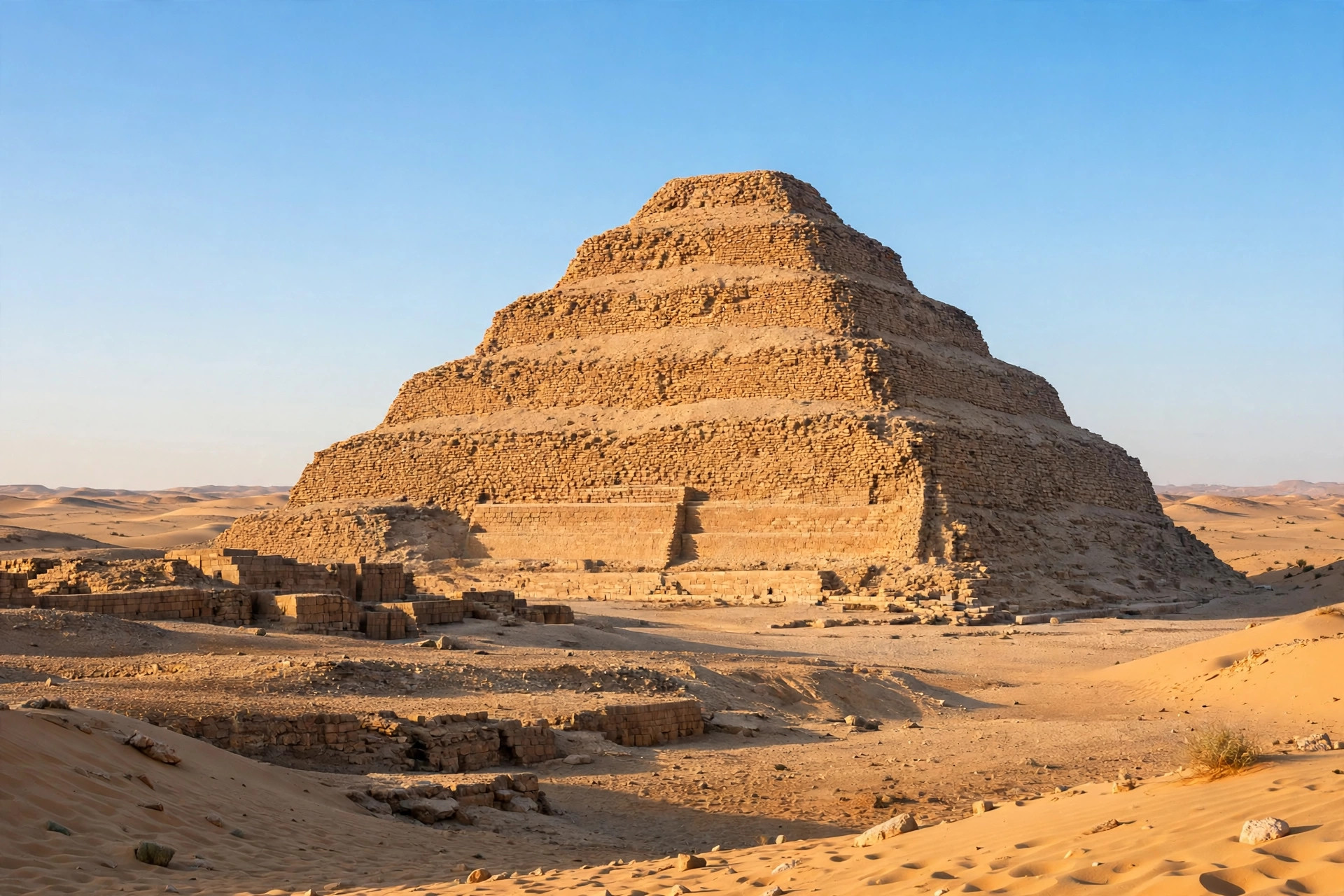
The Old Kingdom, roughly 2686 to 2181 BCE, covering Dynasties 3 to 6, is the Age of the Pyramids. Its first great king was Djoser, who built the Step Pyramid at Saqqara, the first pyramid ever raised, a stack of six stone mastabas that turned a tomb into a mountain. His successors went further: Sneferu built three pyramids of his own, and then Khufu, Khafre and Menkaure raised the three great pyramids of Giza. The capital was still Memphis, and the king was the centre of everything — god, ruler and builder of the state's great works.
These were not the works of a primitive people. The pyramids required surveying, mathematics, quarrying, transport by boat on the Nile and canals, and the organised labour of skilled Egyptian workers. The evidence found at Giza — a workers' town with bakeries, medical care for injuries, and cemeteries beside the pyramids — shows that the builders were organised teams of Egyptians, not slaves. The Old Kingdom also produced the first great literature and art of Egypt, and its administrative system, based on writing and taxation in grain, became the model for the next two thousand years.
Collapse, reunion and the Middle Kingdom
After the Old Kingdom came the First Intermediate Period, roughly 2181 to 2055 BCE, when central power broke down and rival centres at Heracleopolis and Thebes competed for the country. Then Mentuhotep II of Thebes reunited Egypt around 2055 BCE and opened the Middle Kingdom, roughly 2055 to 1650 BCE, covering Dynasties 11 to 13.
The Middle Kingdom is often called the classical age of Egyptian literature. Works such as the Tale of Sinuhe were written in this period, and the art of the time is famous for its realism. The capital was first Thebes and later Itjtawy, and the kings of the 12th Dynasty pushed Egypt's borders south into Nubia and built great irrigation works. The Middle Kingdom ended in weakness, and the Second Intermediate Period, roughly 1650 to 1550 BCE, saw the Hyksos, rulers from the east, control the Delta from their capital at Avaris, until Ahmose I expelled them and founded the New Kingdom.
The New Kingdom, roughly 1550 to 1070 BCE, covering Dynasties 18 to 20, was the peak of Egyptian power. Ahmose I founded it; Hatshepsut, one of the few women to rule as pharaoh, built a great temple at Deir el-Bahari; Thutmose III campaigned deep into Asia; Akhenaten tried to remake religion around a single god during the Amarna Period, roughly 1350 to 1325 BCE; Tutankhamun, who reigned roughly 1332 to 1323 BCE, restored the old gods; and Ramesses II, who reigned roughly 1279 to 1213 BCE, built more monuments than any other pharaoh, including the temples of Abu Simbel.
The capital was Thebes, and its temples, Karnak and Luxor, grew into the largest religious complex of the ancient world. On the west bank of the river, the kings were buried in the Valley of the Kings, in tombs cut deep into the rock. Egypt in this age was an empire, trading and fighting from Nubia to Syria, and its wealth filled the temples and tombs that visitors still see today.
Decline, foreign rule and the end
After the New Kingdom came the Third Intermediate Period, roughly 1070 to 664 BCE, when Egypt was divided again, and kings from Libya and then from Kush, the 25th Dynasty of Nubia, ruled the country. The Late Period, 664 to 332 BCE, covering Dynasties 26 to 30, saw a last revival under the Saite kings, but Egypt's independence was ending. Alexander the Great took Egypt in 332 BCE, and after his death the Ptolemies, a Greek dynasty, ruled from Alexandria until Cleopatra VII. When she died, Rome annexed Egypt in 30 BCE, and the age of the pharaohs was over.
Yet Egypt did not disappear. Its writing, its art, its religion and its monuments shaped the Greek and Roman worlds, and through them the world we live in. The temples were abandoned, the hieroglyphs were forgotten for more than a thousand years, and the sand covered the statues — but the stones stayed, waiting to be read again.
| Predynastic Egypt | c. 5000–3100 BCE — farming villages, towns, early hieroglyphs |
|---|---|
| Unification | c. 3100 BCE — Narmer, identified by most Egyptologists with Menes; capital Memphis |
| Early Dynastic Period | c. 3100–2686 BCE — Dynasties 1–2 |
| Old Kingdom | c. 2686–2181 BCE — Dynasties 3–6, the Age of the Pyramids |
| Middle Kingdom | c. 2055–1650 BCE — reunited by Mentuhotep II; classical literature |
| New Kingdom | c. 1550–1070 BCE — Dynasties 18–20, the imperial peak; capital Thebes |
| Late Period | 664–332 BCE — Dynasties 26–30 |
| Ptolemaic rule | 332–30 BCE — Alexander, then the Ptolemies, ending with Cleopatra VII |
| Rome annexes Egypt | 30 BCE |
Watch: Why Ancient Egyptians Abandoned the Pyramids (Full Episode) | Lost Treasures of Egypt | Nat Geo (National Geographic)