Alexandria: The Ancient City of Alexander
Alexandria is unlike any other city in Egypt. Founded by Alexander the Great in 331 BCE on the Mediterranean coast, it became the capital of Greco-Roman Egypt and the ancient world's great centre of trade and learning. It was home to the Great Library and to the Lighthouse of Pharos, one of the Seven Wonders of the Ancient World — and today it is Egypt's second-largest city and its largest seaport.
The city Alexander founded
When Alexander the Great founded Alexandria in 331 BCE, he chose a narrow strip of land between the Mediterranean Sea and Lake Mariout, with a natural harbour sheltered by the island of Pharos. After his death the city passed to his general Ptolemy, whose dynasty ruled Egypt from Alexandria for three centuries, until the death of Cleopatra VII and the Roman annexation in 30 BCE. Under the Ptolemies, Alexandria grew into the largest city of the ancient world and its main centre of trade and culture, where Greek, Egyptian and Jewish communities lived side by side and ships from across the Mediterranean crowded the harbours.
Much of the ancient city now lies under the modern one, and some of it lies under the sea. Alexandria was shaken by earthquakes over the centuries, and parts of the royal quarter sank into the harbour. What survives above ground is only a fragment of the ancient city, which makes the monuments that do remain — the citadel, the catacombs, the pillar and the amphitheatre — all the more precious. The tomb of Alexander himself has never been found, and its location remains unknown despite centuries of searching.
The Great Library — and the library that replaced it
The Great Library of Alexandria was one of the largest and most significant libraries of the ancient world, a centre of scholarship under the Ptolemies in the 3rd century BCE. Scholars from across the Greek world came to Alexandria to study, and the library's collections grew through purchases, copies and the books taken from ships that docked in the harbour. It was here that Euclid wrote his geometry, that the Hebrew Bible was translated into Greek, and that the astronomer Eratosthenes measured the circumference of the Earth.
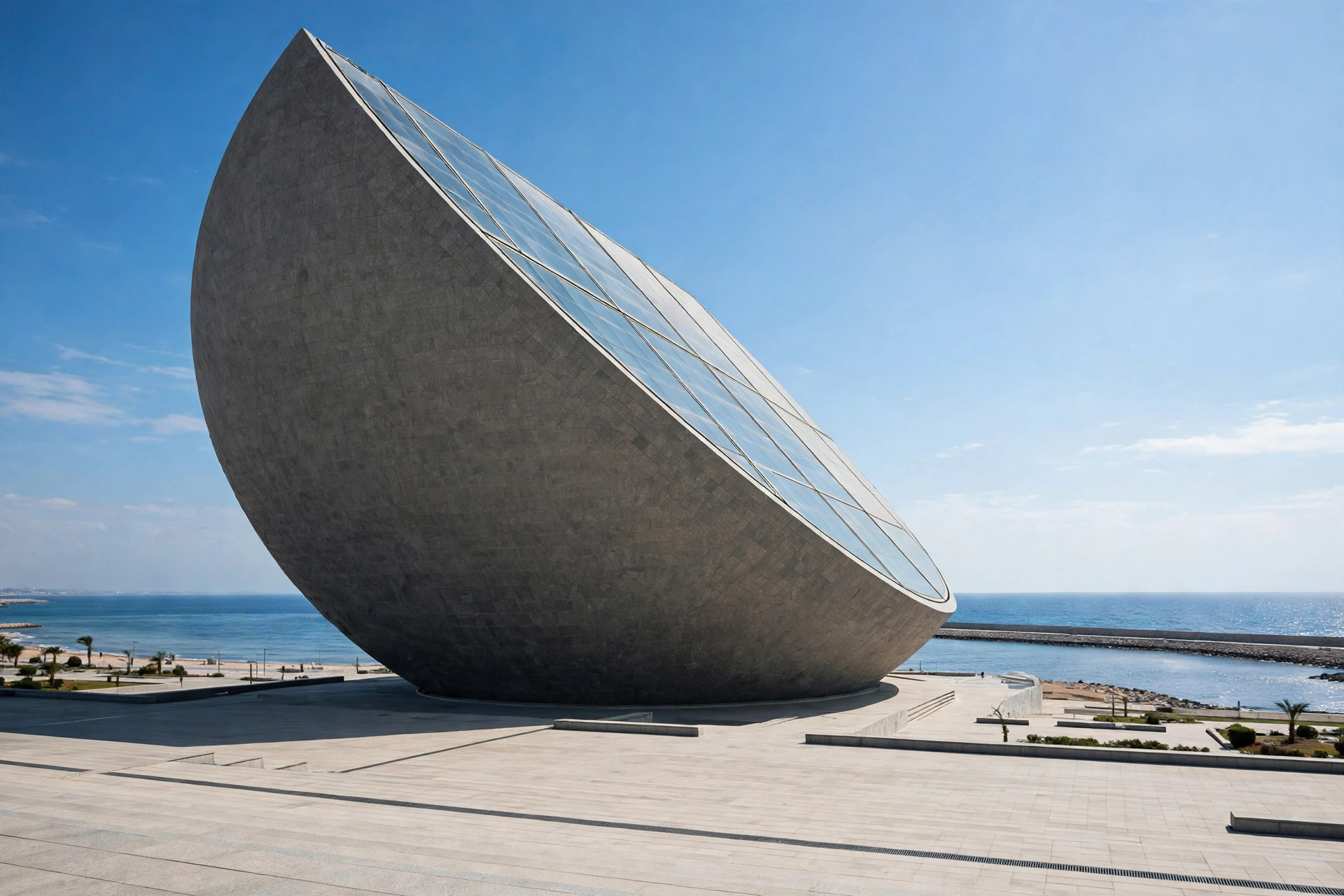
The library did not disappear in a single fire. Its destruction was gradual, spread over centuries of war, neglect and changing times, and it is wrong to blame one event or one person for its loss — the fire set during Julius Caesar's siege in 48 BCE was only one episode in a long decline. What matters is what the library stood for: the idea that all the knowledge of the world could be gathered in one place. In 2002 that idea was honoured with the opening of the Bibliotheca Alexandrina, a modern library and cultural centre on the waterfront, built as a memorial and a re-imagining of its ancient predecessor.
The Lighthouse of Pharos
On the island of Pharos, at the entrance to the harbour, stood the Lighthouse of Alexandria, one of the Seven Wonders of the Ancient World. Work on it began under Ptolemy I Soter and it was completed under his son Ptolemy II Philadelphus in the 3rd century BCE. It was a tower of three tiers rising over 100 metres high by most reconstructions — more than 350 feet tall — and ancient accounts said its light could be seen some 34 miles away. It was so famous that the word for lighthouse in many languages, "pharos", comes from its name.
The lighthouse stood for more than a thousand years, guiding ships into the busiest port of the ancient world. It was badly damaged by earthquakes in 956, 1303 and 1323, and after the last of these it fell into ruin, its stones scattered and reused. The exact height is still debated, since reconstructions vary, but every estimate makes it one of the tallest structures of the ancient world. Today its site is marked by the Citadel of Qaitbay, built from the lighthouse's own stones.
The Citadel of Qaitbay
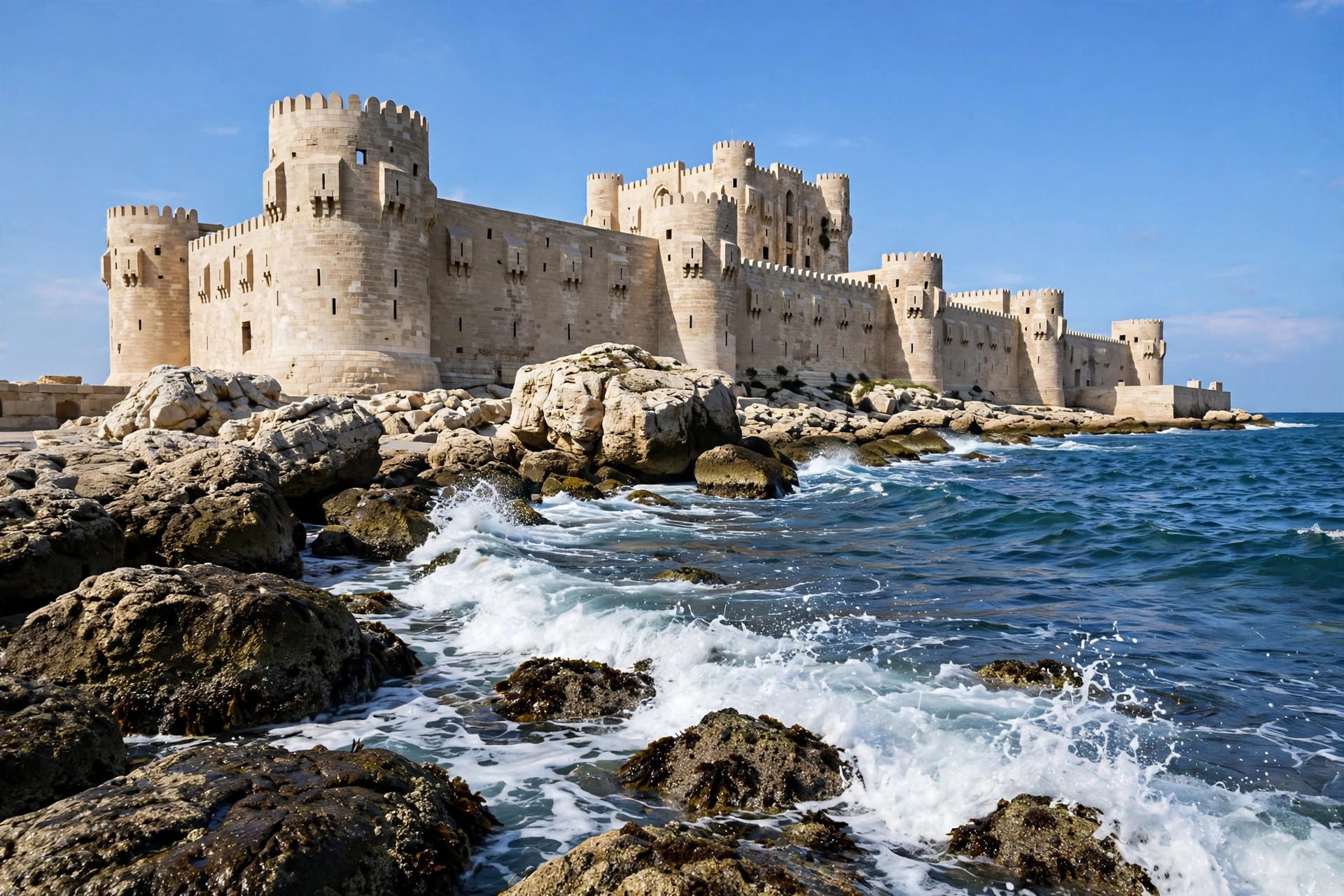
The Citadel of Qaitbay stands on the island of Pharos, on the very site of the ancient lighthouse. It was built by the Mamluk Sultan Qaitbay in 1477 — some sources give 1480 for the building work — as a fortress to guard the harbour, and it was constructed in part from stone taken from the ruined lighthouse. Its round towers and thick walls look out over the Mediterranean from the end of the eastern harbour, and for centuries it was the key to the defence of Alexandria.
The citadel remained in military use until the British bombardment of Alexandria in 1882, and it has been restored in modern times as one of the city's great landmarks. Standing on its walls, you can look across the harbour to the modern city and imagine the lighthouse that once rose from this same rock, guiding ships home across the Mediterranean.
Underground Alexandria: the Catacombs of Kom el Shoqafa
Beneath the streets of modern Alexandria lies one of the most remarkable burial places of the ancient world: the Catacombs of Kom el Shoqafa. This underground complex is thought to date from the 2nd century CE, though some sources place it in the 1st to 2nd century CE, and it is a fusion of Egyptian, Greek and Roman styles — Egyptian gods carved in Roman dress, mummies in Greek style, and banqueting halls where the families of the dead gathered for memorial feasts. Its name means "Mound of Shards", from the broken pottery left by visitors to the tombs. The catacombs were forgotten for centuries and were discovered by chance in 1900, when a donkey fell through the ground into the entrance shaft. They are sometimes listed among the Seven Wonders of the Middle Ages.
Elsewhere in the city, the Roman past survives above ground as well. Pompey's Pillar is a single granite column about 30 metres high, and at Kom el-Dikka stands a Roman amphitheatre, uncovered in the 1960s beneath the modern city. The Alexandria National Museum, opened in 2003, brings the story together with finds from the city and the sea. Alexandria rewards the visitor who looks for it: its greatest treasures are often the ones hidden under the streets, or under the water of the harbour.
| Founded | 331 BCE by Alexander the Great |
|---|---|
| Role | Capital of Greco-Roman Egypt under the Ptolemies; Egypt's second-largest city and largest seaport today |
| Great Library | Centre of scholarship under the Ptolemies, 3rd century BCE; its loss was gradual, not a single fire |
| Bibliotheca Alexandrina | Modern memorial library on the waterfront, opened 2002 |
| Lighthouse of Pharos | One of the Seven Wonders of the Ancient World; begun under Ptolemy I, completed under Ptolemy II; over 100 m by most reconstructions |
| Citadel of Qaitbay | Built by Sultan Qaitbay in 1477 on the Pharos site, reusing stone from the lighthouse; in military use until 1882 |
| Catacombs of Kom el Shoqafa | Underground burial complex, 2nd century CE; fusion of Egyptian, Greek and Roman styles; discovered in 1900 |
| Also to see | Pompey's Pillar (about 30 m); Roman amphitheatre at Kom el-Dikka; Alexandria National Museum, opened 2003 |
Why it matters
Alexandria is the bridge between the Egypt of the pharaohs and the wider world. It was here that Greek and Egyptian culture met and mixed, producing the library that gathered the knowledge of the ancient world and the lighthouse that guided its ships. No other Egyptian city tells the story of the Mediterranean as Alexandria does — a city founded by a Macedonian king, ruled by Greek queens, and still, more than two thousand years later, looking out to sea.
