Siwa Oasis: The Oracle, the Salt Lakes and the Desert
Siwa is the most remote oasis in Egypt, a green island of date palms and olive groves in the Western Desert, about 560 kilometres west of Cairo and about 50 kilometres from the Libyan border. It sits in a depression about 19 metres below sea level, fed by around 200 natural springs, and it is famous for three things: the oracle that declared Alexander the Great a son of god, salt lakes so dense that you float without effort, and a Berber culture that stayed distinct because Siwa was so long cut off from the rest of Egypt.
The Oracle of Amun
The Oracle Temple of Amun stands at Aghurmi, on a rock spur above the palm groves. It is a 6th-century BCE sanctuary, built in the late 26th Dynasty around 550 BCE, and its oracle of Amun — the god the Greeks identified with Zeus — was famous across the Mediterranean from the 7th century BCE. Rulers and travellers crossed the desert to ask it questions, and its answers carried weight far beyond Egypt.
Its most famous visitor was Alexander the Great. In the winter of 332–331 BCE, after founding Alexandria, Alexander crossed the desert to consult the oracle at Siwa, and was declared son of Amun — sealing his divine legitimacy as pharaoh of Egypt. Sources split on whether the visit fell in 332 or 331 BCE, so the winter of 332–331 BCE is the honest way to date it. The declaration mattered enormously: Alexander had conquered Egypt without a battle, and the oracle's word gave him a sacred claim to rule it. The temple itself is modest in size compared with the great temples of the Nile Valley, but few places in Egypt carry so much history in so small a space. Standing on the rock at Aghurmi, looking out over the palm groves, it is easy to understand why the Greeks thought of this as the edge of the known world — and why a conqueror would cross a desert to be told who he was.
Shali and the Old Town
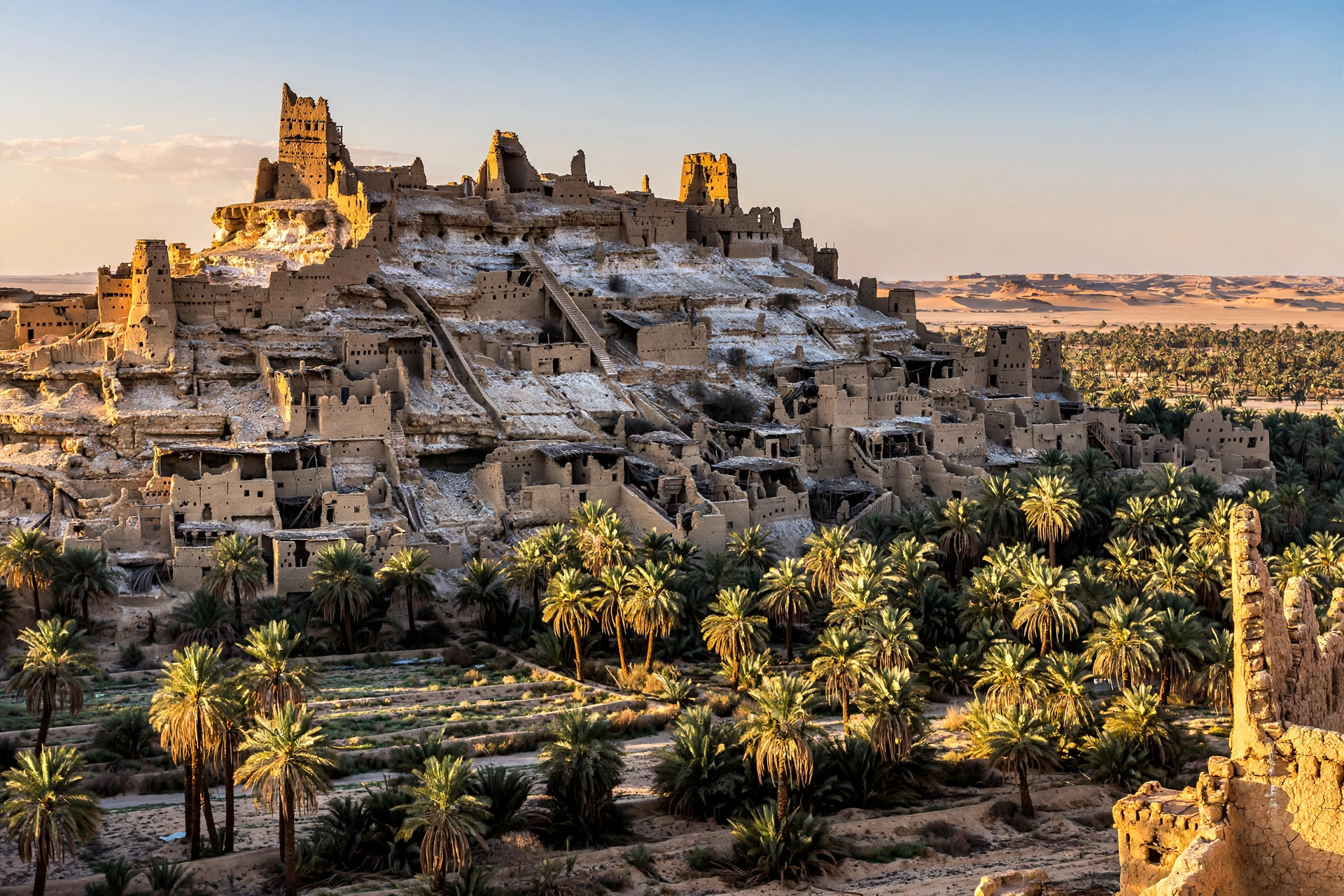
In the centre of Siwa stands Shali, the old fortified hill town, built of kershef — blocks of salt and mud mixed with clay, strengthened with palm logs. Egypt's Ministry of Tourism and Antiquities dates Shali to the 6th century AH, which is the 12th century CE, although many travel guides say the 13th century; the Ministry's 12th-century date is used here. For centuries the people of Siwa lived inside its walls, protected from raiders and from the desert, in houses stacked one above another up the hill.
Shali was largely abandoned after three days of heavy rain in 1926 dissolved its salt-mud walls, and the residents moved down to the plain below, where the modern town now stands. The ruins stood crumbling for decades until a European Union-funded restoration project repaired the walls and stairways, and Shali reopened to visitors in 2020. Climbing to the top today gives the best view in the oasis: palm groves in every direction, salt lakes shining in the distance, and the desert closing in beyond the green. Inside the old town stands the Al-Ateeq Mosque, described by the Ministry as the oldest mud-built mosque in Africa — a reminder that Siwa's history did not stop with the pharaohs, and that the oasis has been a Muslim community for centuries.
Salt Lakes and Springs
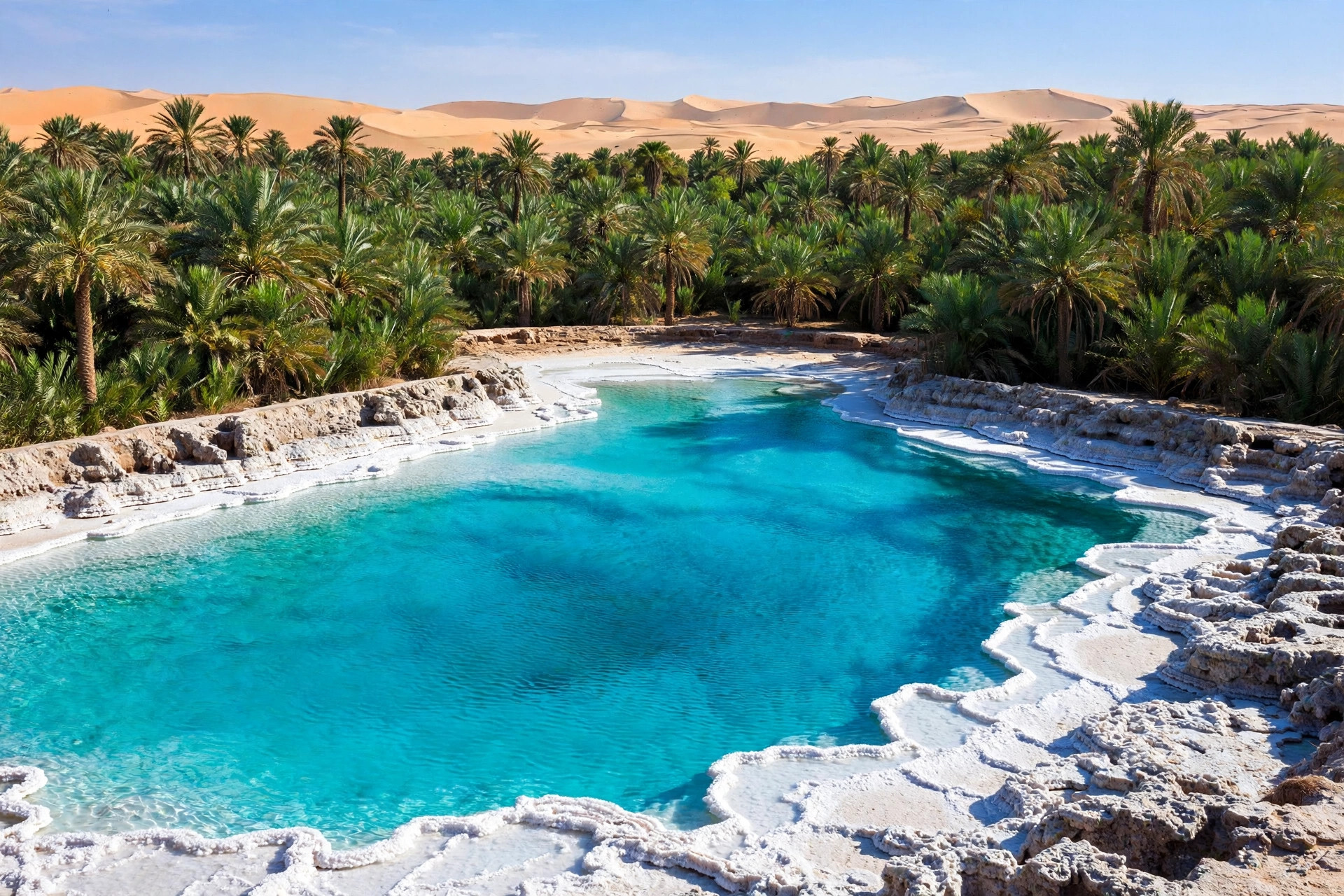
Siwa's strangest and most delightful experience is its salt lakes. West of the town, old salt quarries have filled with hyper-saline water, so dense that you float without any effort at all, even if you cannot swim. Birket Siwa and Birket Zeitun are the main lakes, and the water is warm, clear and startlingly turquoise against the white salt crusts that line the shore. Fatnas Island, on Birket Siwa, is the classic sunset spot in the oasis, where the sun sinks behind the palm trees and the lake turns gold.
The oasis is fed by around 200 natural springs, and its groves hold around 300,000 date palms and olive trees — both figures are travel-guide estimates, so they should be read as approximate rather than exact counts. The best-known spring is Cleopatra's Bath, also called Ain Juba or the Spring of Juba, a stone-rimmed spring-fed pool on the road to Aghurmi. Its name is folklore: there is no evidence that Cleopatra ever bathed there, and the name should not be presented as history. Some guides also call it the Spring of the Sun. Whatever the name, it is a cool, clear pool under the palms, and it shows how water — not stone — is the real treasure of an oasis.
| Location | Western Desert, about 560 km west of Cairo, about 50 km from the Libyan border |
|---|---|
| Elevation | About 19 m below sea level, in a desert depression |
| Water and palms | About 200 natural springs; about 300,000 date palms and olive trees (guide estimates) |
| Oracle Temple of Amun | 6th-century BCE sanctuary at Aghurmi, c. 550 BCE; oracle famous from the 7th century BCE |
| Alexander's visit | Winter of 332–331 BCE; declared son of Amun, sealing his legitimacy as pharaoh |
| Shali fortress | Built of kershef (salt-and-mud blocks); 12th century CE per the Ministry of Tourism and Antiquities — some guides say 13th century |
| Shali abandoned | After three days of heavy rain in 1926; restored and reopened to visitors in 2020 |
| Salt lakes | Birket Siwa and Birket Zeitun; hyper-saline pools where you float without effort |
Siwan Culture and the Desert Around
Siwa's people speak Siwi, a Berber language that is still the daily language of the town. The oasis was historically so isolated — a long desert road from Marsa Matruh on the Mediterranean coast is the only way in — that its culture, crafts and customs stayed distinct from the rest of Egypt. Siwan embroidery and silver jewellery are famous, with patterns and techniques passed down through generations, and Siwan weddings and festivals keep customs found nowhere else in the country. The isolation that once made Siwa hard to reach is now part of its appeal: it feels like a different Egypt, slower, quieter and closer to the desert.
Just outside the town, about one kilometre to the north, stands Gebel al-Mawta, the Mountain of the Dead — a hill of rock-cut tombs, mostly Ptolemaic and Roman in date, including the Tomb of Si-Amun, noted for its painted scenes. West of the oasis lies the Great Sand Sea, one of the largest dune fields on earth, stretching towards Libya. The contrast is the essence of Siwa: a green, watered world of palms and salt lakes, ringed by one of the driest landscapes on the planet, and at its heart an oracle that once told the most powerful man in the ancient world that he was the son of a god.
