Coptic Cairo: The Hanging Church and Old Cairo's Christian Heritage
In the south of modern Cairo, inside the walls of an ancient Roman fortress, lies Coptic Cairo — the oldest Christian quarter of the city and the heart of Egyptian Christianity for more than seventeen centuries. Its churches, its museum and its synagogue stand within a few streets of one another, and together they tell the story of a faith that took root in Egypt while the Roman Empire still ruled the Nile.
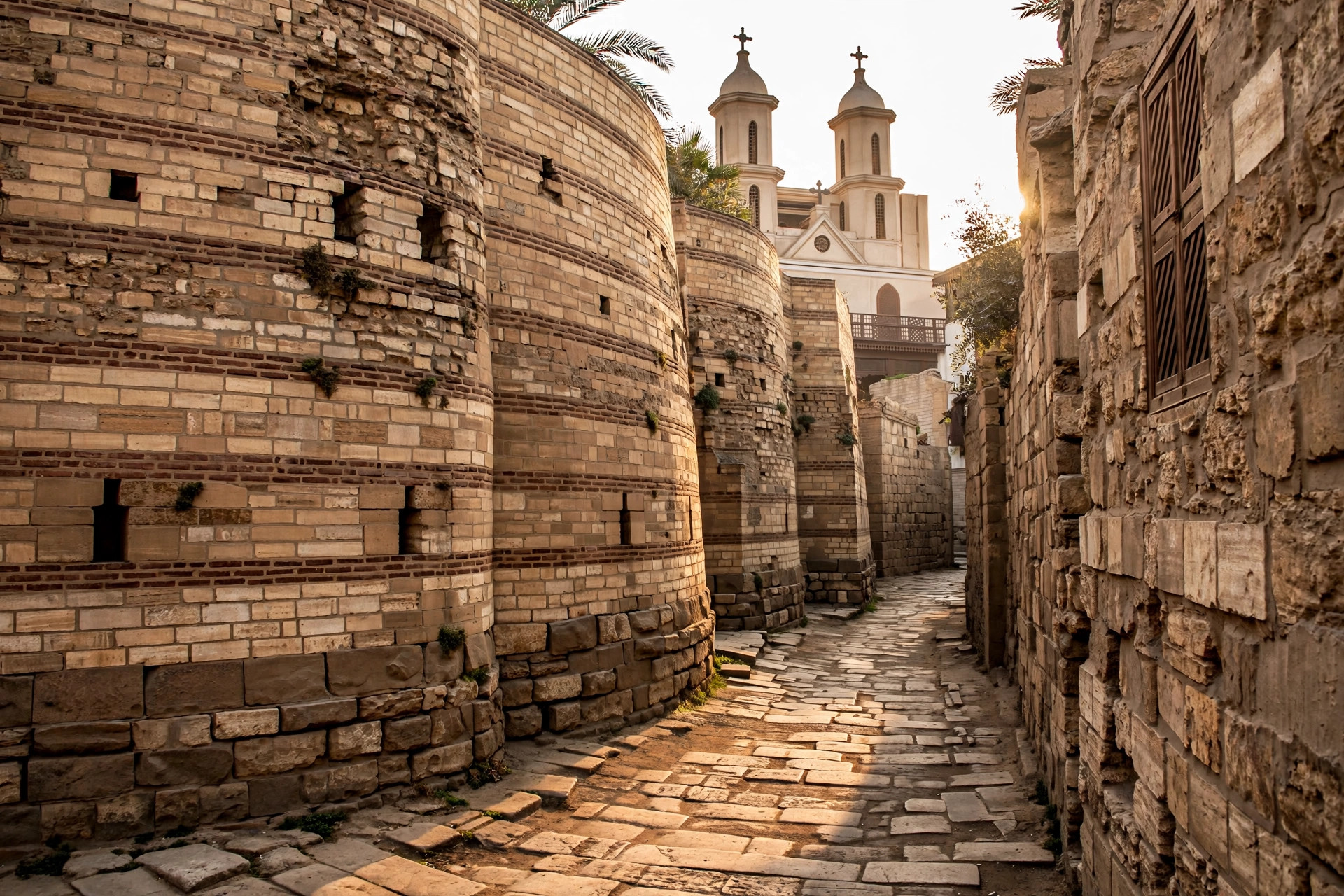
The fortress of Babylon
Coptic Cairo sits on the site of the Roman fortress of Babylon, built around the 1st century CE to guard a crossing of the Nile. The fortress walls and round towers still stand, and the churches of the quarter were built inside and over them. In the 3rd and 4th centuries, as Christianity spread through Egypt, the area inside the fortress became a centre of Egyptian Christianity, and it has remained so ever since. The Coptic Church traces its origins to Saint Mark, who is said to have brought the faith to Alexandria in the 1st century, and the Christians of Egypt kept their own traditions, language and art through centuries of Roman, Byzantine and Islamic rule.
To walk through Coptic Cairo today is to walk through that history in layers. The Roman walls are the foundation; the churches rise above them; and just outside the fortress walls, in nearby Fustat, stands the Mosque of Amr ibn al-As, founded in 641–642 CE, the first mosque in Egypt and in Africa. Within a short walk, the visitor passes from Roman Egypt to Christian Egypt to Islamic Egypt.
The Hanging Church
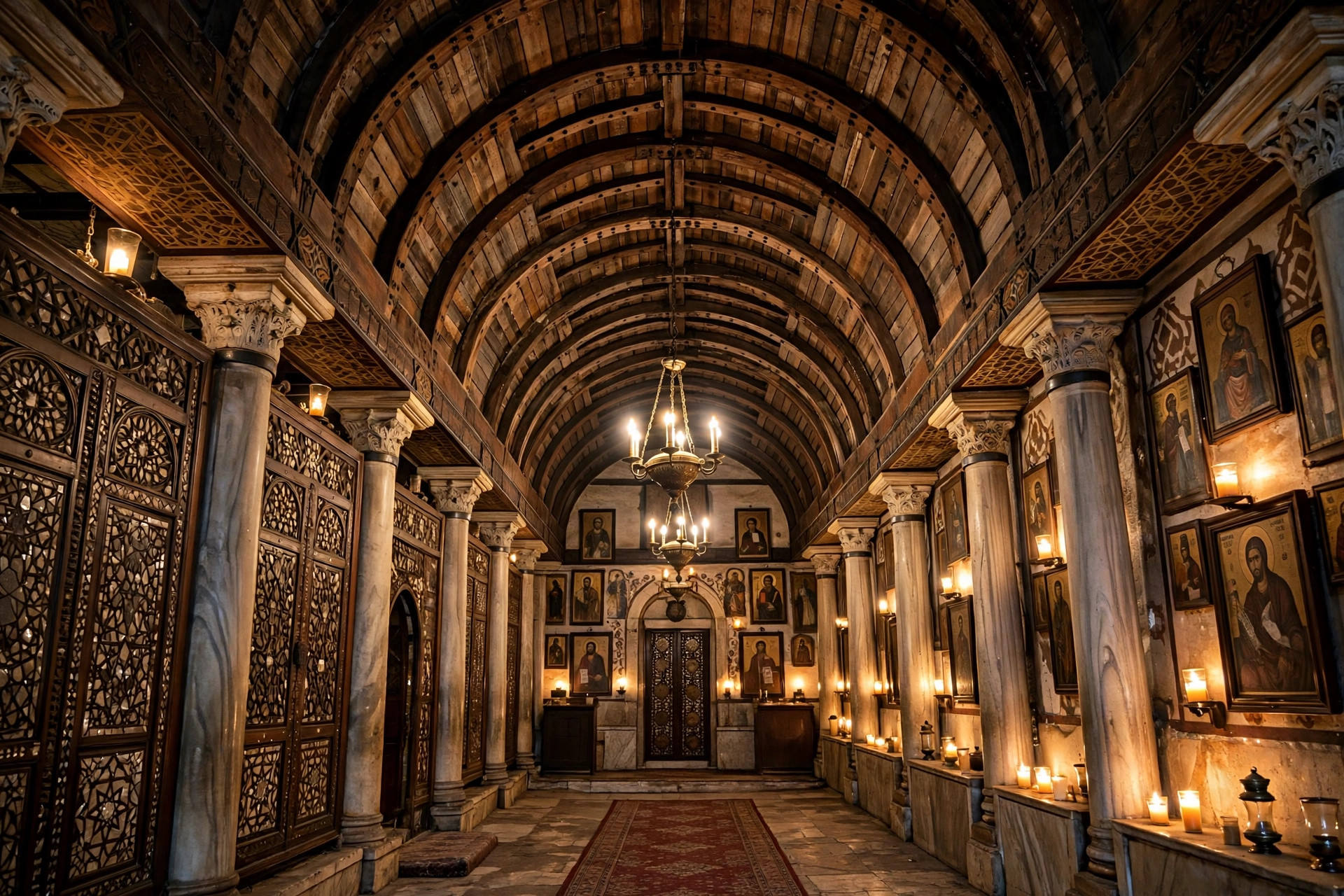
The most famous church of the quarter is the Hanging Church, known in Arabic as El Muallaqa and dedicated to Saint Mary. It takes its name from its position: the church is built above, and suspended over, the southern gatehouse of the fortress of Babylon, so that its nave seems to hang between the two round towers of the gate. A church has stood on this spot since at least the 3rd or 4th century, though the building that stands today is largely the product of later restorations and rebuilding over many centuries — it would be wrong to date the present church to the 3rd century.
For a long time the Hanging Church was the seat of the Coptic Patriarch, the head of the Coptic Church, and it remains its most beloved church. Inside, the wooden ceiling is shaped like the hull of a ship turned upside down, a shape the tradition reads as Noah's Ark, and the church is noted for its marble pulpit, its carved wooden screens and its icons. The courtyard outside is shaded by palm trees, and the sound of the city fades behind the fortress walls.
Abu Serga and the Holy Family
Not far from the Hanging Church stands the Church of Saint Sergius and Bacchus, known as Abu Serga. It is a basilica of the 4th to 5th century — sources differ on whether to date it to the 4th or the 5th century — and it is built over a crypt that tradition holds sheltered the Holy Family during the Flight into Egypt, when Mary and Joseph fled with the infant Jesus from Herod and took refuge in Egypt. The tradition is ancient and deeply held, but it is a matter of faith rather than proven history, and it should be presented as tradition.
The church is one of the oldest in Cairo, and its crypt is the most sacred part of the building: a small, low chamber beneath the sanctuary, reached by a narrow stair, where pilgrims have prayed for centuries. The basilica above is a plain, dignified building of stone and wood, with columns taken from older Roman buildings — a common practice in early Christian churches, and one more sign of how the churches of Coptic Cairo were built on and from the Roman world around them.
Ben Ezra Synagogue and the Cairo Geniza
Within the same quarter stands the Ben Ezra Synagogue, one of the oldest synagogues in Egypt. The building began as a Coptic church in the 4th century, and in the 9th century it was sold to the Jewish community and converted into a synagogue. Its history is a reminder that the old city was shared: churches, synagogues and, nearby, mosques stood within a few minutes' walk of one another. Local legend links the site to the finding of the baby Moses in the reeds of the Nile, but that is legend, not established history.
The synagogue is world-famous for what was found in its storeroom. In the late 19th century, scholars discovered in its geniza — the room where worn-out sacred writings were stored rather than destroyed — the Cairo Geniza, a collection of hundreds of thousands of medieval manuscripts, letters and records. The documents, written over nearly a thousand years, record the everyday lives of the Jewish community of Cairo and Fustat: marriages, business deals, lawsuits, letters from distant ports, and the workings of a medieval Mediterranean world. They are one of the richest archives of the medieval world, and they were found in a small synagogue inside a Roman fortress.
The Coptic Museum
Beside the fortress walls stands the Coptic Museum, founded and opened in 1908 by Marcus Simaika Pasha. It holds one of the largest and richest collections of Coptic Christian art in the world: textiles woven with scenes from the Bible and from daily life, illuminated manuscripts, icons, and stone carvings from churches and monasteries across Egypt, from the early Christian era through to the Islamic period. The museum building itself, with its carved wooden ceilings and mashrabiya screens, is a work of art in its own right, and its galleries show how Egyptian Christianity kept the art of the pharaohs alive in a new faith — the same stone carvers, the same weavers, now working for a church instead of a temple.
Coptic Cairo is not a ruin and not a museum quarter alone: it is a living community, and its churches still fill with worshippers. That is what makes it different from the temples of Luxor or the pyramids of Giza. Here the history did not stop. The churches built over a Roman fortress are still used, the museum still studies the art, and the quarter still belongs to the community that has kept it for seventeen centuries.
| Site | Built over the Roman fortress of Babylon, c. 1st century CE; centre of Egyptian Christianity from the 3rd–4th centuries |
|---|---|
| Hanging Church | El Muallaqa, Church of St Mary; built over the southern gatehouse of Babylon Fortress; a church has stood here since at least the 3rd or 4th century; long the seat of the Coptic Patriarch |
| Abu Serga | Church of St Sergius and Bacchus, 4th–5th century basilica; crypt traditionally held to have sheltered the Holy Family |
| Ben Ezra Synagogue | Originally a 4th-century Coptic church; sold to the Jewish community in the 9th century; home of the Cairo Geniza, found in the late 19th century |
| Coptic Museum | Founded and opened 1908 by Marcus Simaika Pasha; one of the largest collections of Coptic Christian art in the world |
| Neighbour | Mosque of Amr ibn al-As, nearby in Fustat, founded 641–642 CE, the first mosque in Egypt and Africa |
Why it matters
Coptic Cairo is where the Egypt of the pharaohs became the Egypt of the Christians, and where the two worlds met without breaking apart. Its churches were built on Roman walls, its art kept the skills of the ancient carvers and weavers, and its synagogue preserved one of the great archives of the medieval world. In a single quarter, within a short walk, the visitor can trace Egypt's story from Rome to Christianity to Islam — and find a community that still worships where its ancestors worshipped seventeen centuries ago.
